Alpe d'Huez Skiing Guide: Pistes, Sectors, Passes and Bases
Plan Alpe d'Huez skiing with our guide to 250 km of pistes, five resort bases, lift-pass choices, beginner zones and ski schools.
On this page
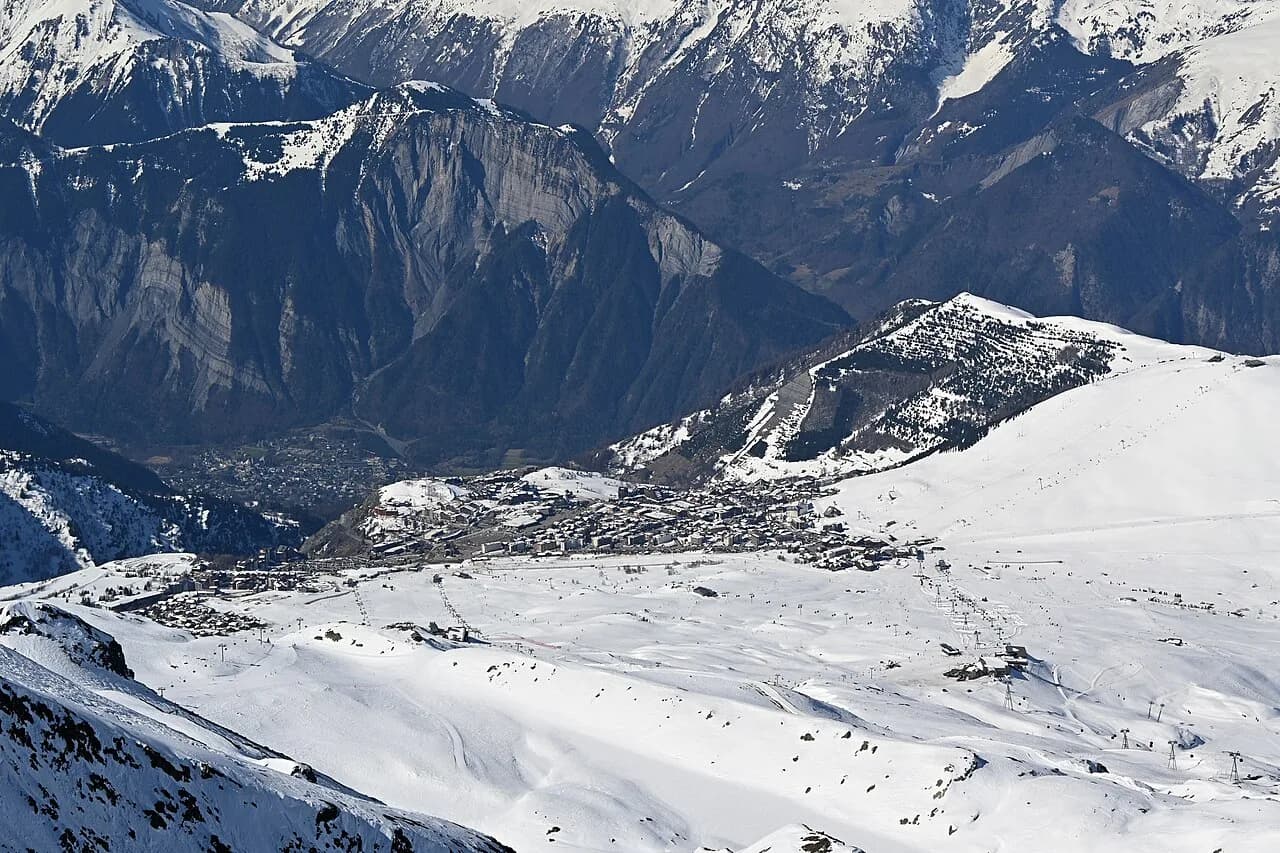
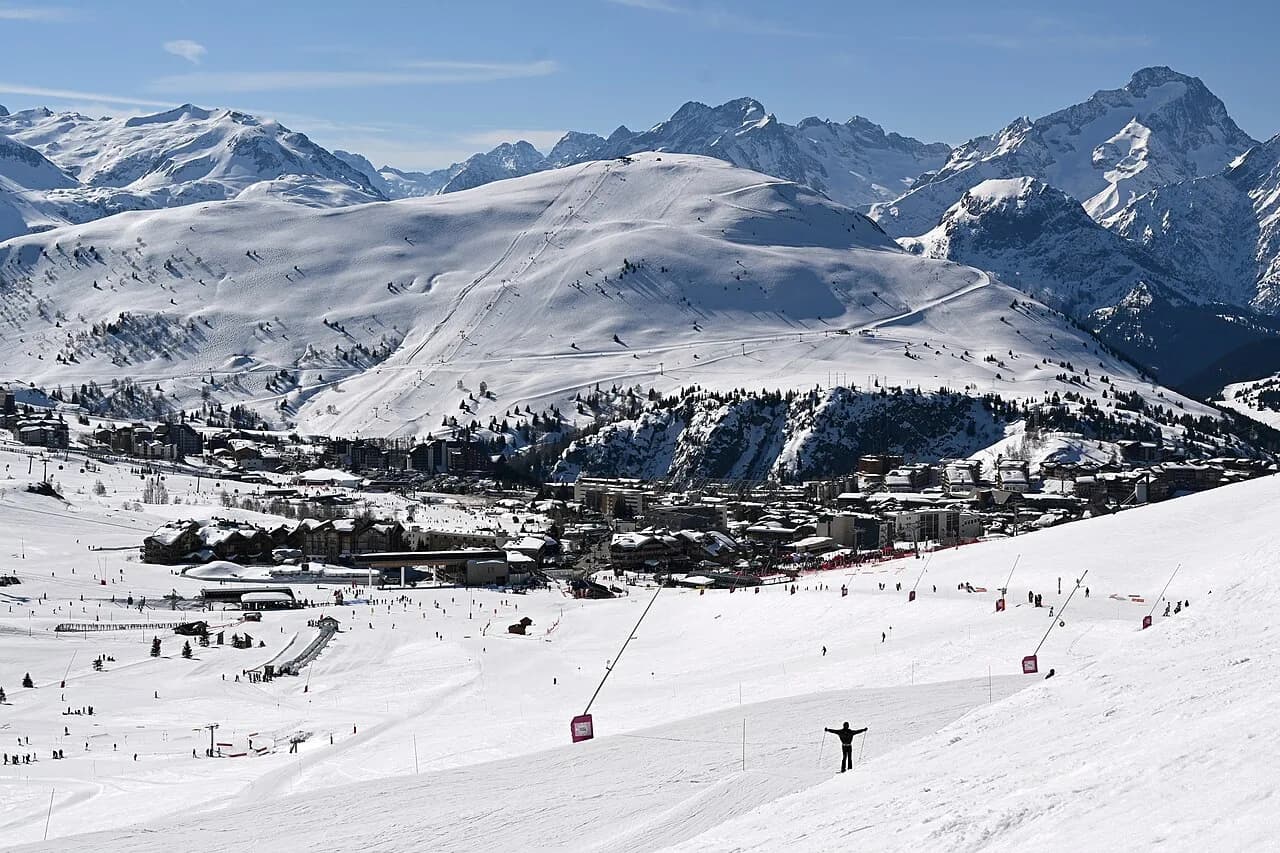
Alpe d'Huez is one of the few Alpine resorts where the skiing genuinely starts at village level and finishes on a glacier. The resort sits at 1,860 m, the lifts climb to the Pic Blanc at 3,330 m, and in between there are 250 km of patrolled pistes shared by five resorts. That combination of altitude, scale and a compact, walkable main village makes it a strong choice for a mixed-ability group that does not want to split up all week.
What catches people out is the layout. The Espace Alpe d'Huez is not one resort with a big car park; it is Alpe d'Huez, Oz-en-Oisans, Vaujany, Auris-en-Oisans and Villard-Reculas, each with its own altitude and character, all joined under one lift pass. Choosing where to base yourself is effectively choosing your morning routine, your transfer time and your evening atmosphere, so decide that before you start comparing apartments.
The Mountain at a Glance: Scale, Altitude and Vertical
The ski area covers 250 km of slopes, with 111 marked pistes: 34 green, 31 blue, 30 red and 16 black. The top lift reaches 3,330 m at Pic Blanc, and the vertical drop is around 2,000 m, which is why long top-to-bottom descents are the defining experience here rather than lap-after-lap of short runs. The lower edge of the area drops to around 1,250 m at Vaujany, so the lower slopes can soften earlier in the day during mild spells while the glacier stays cold and firm.
That range matters for planning. A south-facing area with high-altitude terrain gives bright, sun-softened snow on lower slopes and reliable cover up top, so you can follow the sun rather than commit to one sector. The trade-off is that spring afternoons on low runs can be slushy while the top stays wintry, which is a good excuse to ski high early and finish low late.
The official resort site describes more than 300 days of sunshine a year and 250 km of slopes, with 135 trails served by its lift network; the piste map counts 111 marked pistes in the current tally. Those differences come from how runs are counted and how sectors are defined, so use the 111 figure for route-planning and treat 135 as a broader count of trails. Neither number should change your booking, but the altitude band should: it tells you snow is more reliable above the mid-mountain than below it.
Read the map before you buy anything. The full-area pass covers the whole network, but the different villages connect through specific lifts and ridges, and some sectors stand alone at lower altitude. The Alpe d'Huez Ski Map guide explains the map types, including the beginner and Nordic versions, so you can see which runs sit above your chosen base before you commit to accommodation.
Sector by Sector: Where the Skiing Actually Happens
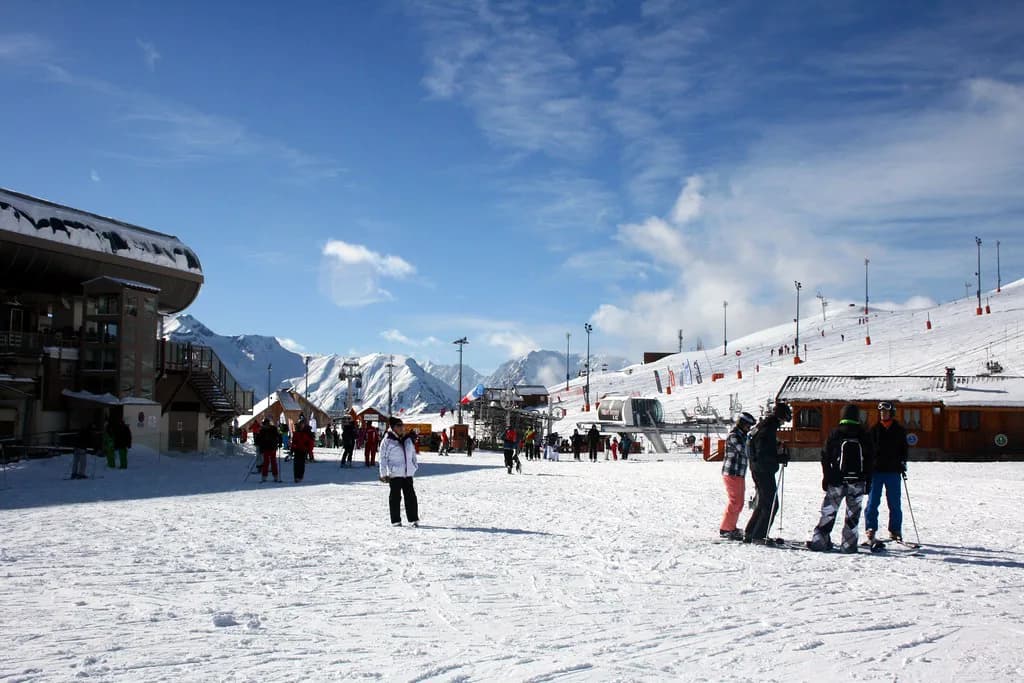
Alpe d'Huez village at 1,860 m is the hub. The Grandes Rousses and Bergers sides give you direct access to the main high-mountain lifts, and the Rif Nel area, near where the children's ski school meets, provides gentle terrain right above the buildings. This is the base to choose if you want to walk to lifts, restaurants and bars rather than drive or take a shuttle.
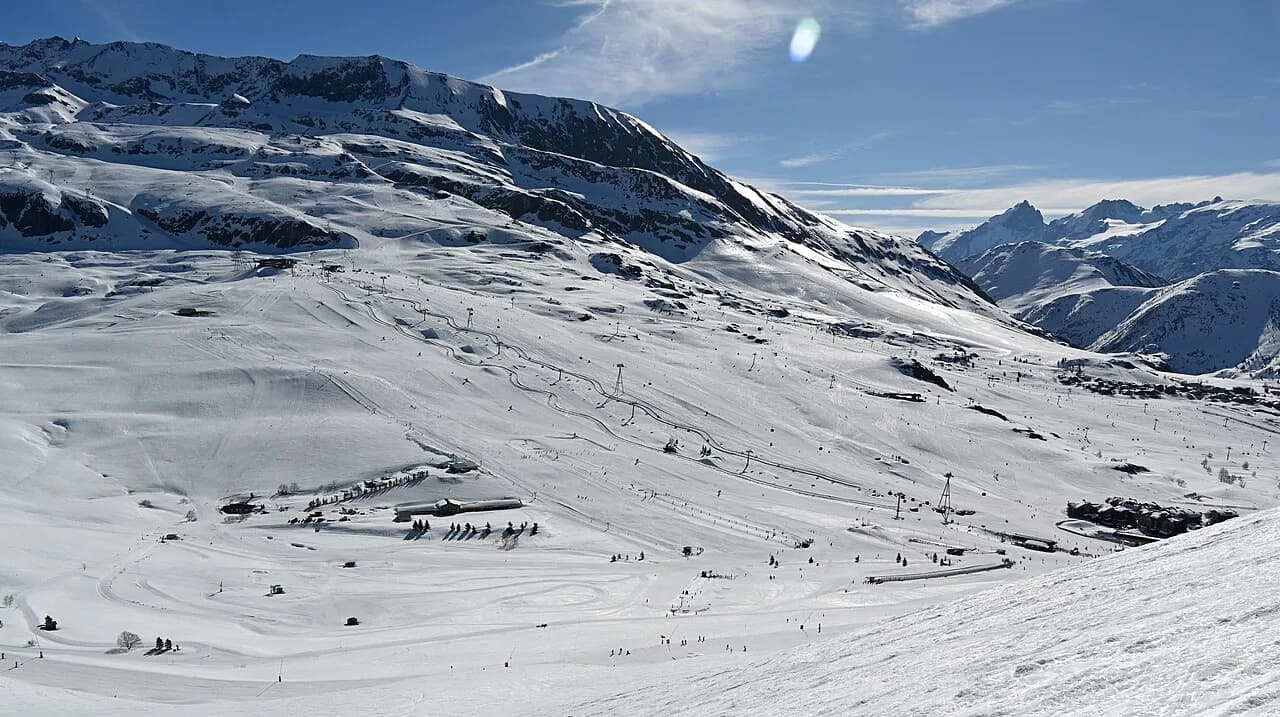
Montfrais sits above Alpe d'Huez and serves as an intermediate stepping stone, with a chairlift and its own snowpark accessed via the Myrtilles slope. The Bergers sector has its own chairlifts and a snowpark aimed at riders who have mastered the basics. These two areas are where confident beginners and low intermediates will spend most of their week, because the runs are pitched at that level and the lift queues are generally lighter than at the main gondolas.
Oz-en-Oisans, with the high point of Oz 3300 at 1,350 m, is the gateway on the western side, and Vaujany at 1,250 m links into the same network via its own cable car. These villages are quieter and more traditional than the main resort, and their altitude means you often start a few hundred metres higher on the mountain than the village itself suggests. If your priority is snow-sure access and a calm evening, they are the better base; if you want nightlife, they are not.
Auris-en-Oisans at 1,600 m and Villard-Reculas at 1,500 m complete the five. Villard-Reculas has the Vallons sector, with a snowpark rated from S to L and a boardercross course, served by the Signal Telemix, Villarais chairlift and Petit Prince drag lift. Auris is family-oriented and sun-facing, with ski-in and ski-out convenience from much of its accommodation. Both are better for people who value easy slope access over big-resort facilities.
Which Terrain Suits Which Ability
First-timers are well served at village level. The beginner zones sit close to the main base, with green runs and dedicated learning areas that the piste map marks separately, and the piste map guide covers the beginner map specifically. Book a base near the Grandes Rousses or Bergers meeting points so the walk to lessons is short in ski boots, which matters more than it sounds with small children.
Intermediates have the largest playground. The 31 blue and 30 red runs spread across all five sectors, and the linked nature of the area means you can plan a day that traverses from Alpe d'Huez to Oz or Vaujany without repeating a run. The trick is to check the return lifts before you commit to a distant sector, because some connections close earlier than the runs themselves, particularly in early and late season.
Advanced skiers come for the 16 black runs and the high-mountain off-piste. The Pic Blanc lifts open up steep terrain and the famous Sarenne descent, and the snowpark expert line at Stade sportif des Jeux, reached from the Grandes Rousses sector via the Jeux Telemix, has 12 to 25 m tables. That zone is sometimes closed for competitions and training, so check opening conditions before you build a day around it.
Freestyle riders get five snowparks and two boardercross courses spread across the area, graded from XS for children and first-timers up to L and XL. The Kids Park des Sagnes, reached by the Sagnes drag lift, and the T-Park near Montfrais are the entry points for younger riders. Moving up, the Bergers and Montfrais parks add boxes and small kickers, while the Vallons park in Villard-Reculas offers S, M and L lines.
The Signature Runs: Sarenne, Pic Blanc and High-Altitude Skiing
The Sarenne is the run most people have heard of. The official resort describes it as a 16 km uninterrupted descent and the longest black run in the world; the lift-pass site calls it Europe's longest black run. Either way, it is a long, sustained descent that will exhaust legs and concentration, so treat it as a morning objective with fresh legs, not an end-of-day add-on. Its length also means you need to manage the return trip, because finishing in the wrong valley costs time.
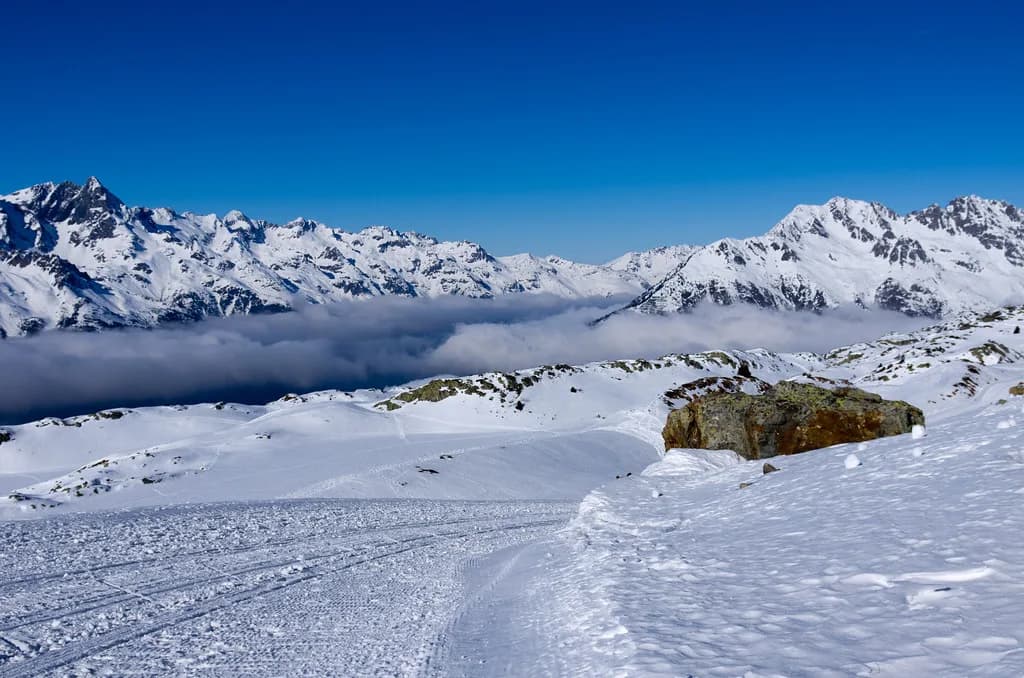
Pic Blanc at 3,330 m is the high point of the area and the start of the steepest and most exposed skiing. Lifts from the village, including the DMC, take you up to the glacier zone, where the Grotte de Glace ice cave is also located, and the views on a clear day stretch to Mont Blanc and Mont Ventoux. Visibility and wind up there can be very different from the village, so check the lift and weather status before going high.
The vertical drop of around 2,000 m means top-to-bottom runs are genuinely long, and you can link several descents into a single morning if you plan the lifts. The trade-off is return logistics: once you descend to a lower village, getting back to your starting point may involve a specific lift sequence, so carry the piste map or use the resort app. High-altitude skiing here is less about technical difficulty than about reading the mountain and choosing your exit.
Snowparks and Freestyle Zones
The freestyle offering is deeper than most resorts of this size. Five snowparks and two boardercross courses are spread across several sectors, with features graded XS through L and XL. The XS areas, Kids Park des Sagnes and T-Park at Montfrais, are designed for children and first-timers, with very small bumps, mini boxes and beginner jumps. That makes the park system useful for families rather than something aimed only at teenagers.
On the progression side, the Bergers snowpark offers wider boxes and more pronounced bumps, while the Montfrais park adds varied features for riders working on first rotations. Vallons in Villard-Reculas is the complete park, with S, M and L lines and a boardercross course, and it is the natural choice if you are staying on that side of the area. The Stade sportif des Jeux is reserved for experienced riders and hosts competitions, so public access is sometimes closed.
There are also four fun slopes aimed at families, with themed areas and features for progressing together rather than only for freestyle specialists. If you are travelling with a mix of ages, these give younger skiers variety without committing to the park. The trade-off is that the parks and fun zones are spread across the area, so pick the ones nearest your base and plan your day around that sector.
Lift Passes: Full Area Versus Sector Passes
The central choice is the full Espace Alpe d'Huez pass versus a sector pass. The full pass covers all five resorts and 250 km of slopes, subject to opening periods and conditions, while the sector passes cover Oz-Vaujany, Villard-Reculas or Auris-en-Oisans and their local lifts. The Oz-Vaujany sector pass, for example, covers 55 km of slopes, so if you are based in Vaujany or Oz and planning to ski mostly locally, the sector product can be the cheaper and simpler choice.
If you are staying in the main village, the full pass is the obvious pick. It gives you the whole network, including the high-mountain lifts, and avoids the awkward situation of being in the wrong sector with the wrong ticket. The trade-off is cost on short trips where you will only ski a few local runs; in that case, ask at the lift-pass office whether a local product suits your plans.
For anyone buying online, the official Alpe d'Huez Ski Pass guide explains coverage, duration and collection options. The key practical detail is that you need a rechargeable pass card to access the lifts, and if you do not have one it can be added to your order for a small fee. Card compatibility is only guaranteed with SATA Group rechargeable cards, so if you already own one from a previous trip, check the number before you buy.
Prices and Where to Buy
Official published lead-in prices give a useful sense of scale. The 1-to-10-day Alpe d'Huez area pass starts from 58.00 €, the season pass from 930.50 € and the annual from 1,038.50 €, with the season pass pre-season offer available until 20 November. The Oz-Vaujany sector pass starts from 49.50 € for 1 to 10 days, with its season product from 556.50 €. Treat these as indicative starting figures, not the price you will pay at Christmas or half-term.
There are also web-only deals with their own conditions. The Saturday ski deal, bookable before Thursday at midnight, starts from 35.50 €, the weekend deal from 93.50 €, and the family deal, for four or more people including two children, from 224.50 €. Group pricing from three people, starts from 266.00 €. The catch is the booking deadline: these work if you can commit early in the week, not if you decide on the morning of skiing.
Season-pass buyers should note the pre-season deadline of 20 November, because the saving is real and the window closes. The season pass covers the full area from 5 December 2026 to 25 April 2027, and can be paid in three instalments without fees on purchases from 250 €, with home delivery rather than on-site collection. That delivery route matters if you are arriving late or want to ski the first morning without queuing.
Where you buy is almost as important as what you buy. The official lift-pass site sells online, with exclusive web offers, and tickets are also available at official sales points and machines at several departure points. If you buy online, using the click-and-collect option at one of the resort pick-up points avoids delivery delays. Allow around ten days for mainland France delivery and longer internationally.
Ski Schools: ESF and ESI, Lessons and Lift Passes
ESF Alpe d'Huez runs private lessons from one hour upwards, with published starting prices of 62 € for a one-hour lesson, 93 € for 90 minutes and 124 € for two hours, all bookable daily and available around lunchtime when the slopes are quieter. Low-season half-day sessions start from 198 € to 218 €, and a full day from 450 €. High-season Christmas and February rates start from 226 € for a half day and 540 € for a full day. Prices are indicative and should be confirmed when booking.
The school publishes its own guidance on matching lesson level to lift pass, which is worth taking seriously. Beginners and Teddy Bear levels should not buy a lift pass before the instructor advises, snowflake and first-star levels are pointed to an initiation package with limited area access, and second-star to team-star levels to a progression package for the whole area. Junior beginners and adult class 1 are pointed to a six-day initiation package covering the full area. That sequencing saves money and avoids buying access you will not use in the first days.
ESI Alpe d'Huez is the smaller, family-run alternative, offering private ski and snowboard lessons and group children's lessons for ages 8 to 12. Its instructors work in French and the school offers preferential rates on equipment rental close to its meeting point. If you want a cosier teaching style rather than a large school system, it is a reasonable second option, and booking online early is wise in school holiday weeks.
Lesson logistics matter as much as school choice. ESF has four sales points in resort, including the Maison de l'Alpe and the Bergers commercial centre, and three lesson departure points at Grandes Rousses, Bergers and the Children's Chalet, so your accommodation should be chosen with the meeting point in mind. Full details of formats and meeting points are set out in the Alpe d'Huez Ski Lessons guide.
Ski Hire and Equipment
Hire is straightforward in a resort of this size, with shops concentrated in the main village near the ESF sales and lesson points at Les Grandes Rousses and Les Bergers. The practical decision is whether to book online before you travel or walk in on arrival. Pre-booking usually secures better availability in peak weeks and lets you specify boots and skis in advance; walk-in gives you the chance to see and try the kit, which some skiers prefer. Either way, collect skis the afternoon before your first day to avoid the morning queue.
If you are taking lessons, check whether your school has a partner shop. ESI offers preferential rental rates near its meeting point, and ESF explicitly does not provide equipment, so you will need a shop either way. Rentals at village level mean you can carry skis a short distance rather than loading them into a car each morning, which is one more argument for choosing accommodation close to a lift base.
Season Dates and When to Book
The official lift-pass pages list the winter season as running from 5 December 2026 to 25 April 2027, and the ESF winter office hours match that window. Those dates are useful for planning, but they are not a guarantee that every lift and run is open from day one; early-season cover depends on conditions, and late April skiing is concentrated on the higher slopes. Check the lift and slope opening status before booking a trip at the very start or end of the season.
Book accommodation and ski school first, then lift passes. The pre-season pass deadline of 20 November is the one date that genuinely rewards early commitment, and private lesson slots in Christmas and February fill earliest. If you are travelling in those weeks, the best-value approach is to lock in dates and lessons well before autumn and buy passes online once you know your arrival day.
Getting There: Airports, Transfers and Driving
Grenoble is the nearest airport, roughly 1 hour 30 minutes by road, and Lyon and Geneva are the other realistic options for UK travellers. From Grenoble you can take a transfer or hire a car; a car is worth it if you plan to explore the valley or stay in one of the outlying villages, but not essential if you are based in Alpe d'Huez itself, where everything is walkable.
Self-drive works well for groups staying in Vaujany, Oz or Villard-Reculas, where village-to-village travel by public transport is limited in the evening. Parking exists in the resort but booking a space with your accommodation is easier than arriving and hoping. If you are staying in the main village for a week and not planning day trips, a transfer is the simpler choice.
Where to Base Yourself: Alpe d'Huez Versus the Villages
Alpe d'Huez itself is the lively option, with accommodation mostly in self-catered apartments within chalet-style buildings and a handful of hotels. Its strength is convenience: you can walk to the slopes, the ski schools and the bars, and you get direct access to the full network. Its weakness is that it is a purpose-built resort rather than a traditional village, which some travellers find less charming than the outlying bases.
Oz-en-Oisans is pedestrian-friendly and family-oriented, with ski-in and ski-out access from much of the accommodation and a peaceful setting among pine trees. Vaujany is a traditional mountain village with high-quality facilities and a relaxed atmosphere, and it connects to the wider area by cable car. Both suit people who want quiet evenings and easy slope access over nightlife.
Auris-en-Oisans and Villard-Reculas are the smallest and most intimate, both with ski-in and ski-out convenience and direct access to the wider network. They are good value for families and for skiers who want a traditional village feel, but they have fewer restaurants and less going on after dark. If you are travelling with a group that wants both a quiet base and a big night out, the main village remains the safer bet.
If you are weighing up other French resorts, our Flaine ski guide covers a smaller, purpose-built option, while the La Plagne Skiing Guide covers a much larger multi-village area. Alpe d'Huez sits between the two on scale, with the advantage of glacier access and a walkable main base, which is hard to match elsewhere in the French Alps.
Beyond Skiing: Pedestrian Passes and Non-Ski Activities
Non-skiers do not have to sit in the apartment. The winter season pedestrian pass costs 213.50 € for the whole season for ages 5 to 71, with a senior 72+ rate of 64.00 €, and covers lifts open to pedestrians for views, walks and mountain restaurants. Shorter pedestrian holiday passes are available from 27.00 € for one to six days. It cannot be used for skiing, so skiers in the group still need their own pass.
Other options include the Grotte de Glace ice cave at the top of the DMC lift, paragliding, ice climbing, snowmobiling and mountain karting. The resort also has a reputation for nightlife, with bars and clubs in the main village, which is another argument for basing there if you want to go out after skiing rather than drive back to a quiet village.
The Verdict: Who Alpe d'Huez Suits
Alpe d'Huez suits mixed-ability groups who want a big linked area without splitting into separate resorts. The combination of 250 km of pistes, 2,000 m of vertical, glacier access and a compact main village gives beginners, intermediates and advanced skiers a reason to stay in the same place. It is also a good choice for families, with beginner terrain at village level and schools that meet at the bottom of the slopes.
It is less well suited to skiers who want a traditional Alpine village atmosphere at the lift base, or to anyone who wants a small, intimate area with everything within a few hundred metres. Those travellers should look at Villard-Reculas or Auris within the same area, or a smaller resort such as Flaine. For everyone else, the practical path is to choose a base, book lessons and passes early, and plan your days around the altitude band rather than the piste count.
Explore more Alpe d Huez guides
- Alpe d'Huez Ski Lessons
- Alpe d'Huez Ski Map
- Alpe d'Huez Ski Pass
- Alpe d'Huez Snowboarding
- Alpe d’Huez Ski Hire
- Alpe d’Huez Ski Season
- Méribel Ski Guide
- Morzine Ski Guide
- Courchevel Skiing
- Avoriaz Skiing
- Val d'Isère Skiing
- Les Gets Skiing
- Les Arcs Ski Guide
- La Plagne Skiing Guide
- Megève Skiing
- Tignes Skiing Guide
- Flaine Skiing Guide
- Les Deux Alpes Skiing
- Val Thorens Skiing Guide
- La Rosière Skiing Guide
- La Clusaz Skiing
- Montgenèvre Skiing
- Serre Chevalier Skiing
- Samoëns Skiing
- Valmorel Skiing
- Val Cenis Skiing
- Les Houches Skiing
- Les Menuires Skiing Guide
- Chamrousse Skiing
- Valmeinier Skiing
- Le Grand Bornand Skiing
- Valloire Skiing
Frequently Asked Questions
How many kilometres of pistes does Alpe d'Huez have?
The Espace Alpe d'Huez covers 250 km of slopes across 111 marked pistes, split into 34 green, 31 blue, 30 red and 16 black. The area runs from about 1,250 m at Vaujany to 3,330 m at Pic Blanc, giving roughly 2,000 m of vertical drop.
Is Alpe d'Huez good for beginners?
Yes. There are beginner zones close to the main village, including the Rif Nel area near the children's ski school meeting point, and dedicated learning areas marked on the beginner map. Beginners should not buy a lift pass before lessons start, because the ski school advises which pass matches your level.
Do I need a full-area lift pass in Alpe d'Huez?
If you are based in Alpe d'Huez village, the full-area pass is the sensible choice because it covers all five resorts and the high-mountain lifts. If you are staying in Vaujany or Oz and skiing mostly locally, the Oz-Vaujany sector pass covers 55 km and may be enough.
What is the longest black run in Alpe d'Huez?
The Sarenne is the signature black run, described by the official resort as a 16 km uninterrupted descent and by the lift-pass site as Europe's longest black run. It is a long, sustained descent, so ski it with fresh legs earlier in the day rather than at the end of the afternoon.
Is Alpe d'Huez expensive?
What you pay depends on the date, the length of your stay and whether you qualify for a family or group deal, and rates rise sharply in school holidays. The official Alpe d'Huez lift-pass site lists current prices for day, multi-day, season and sector products, so compare the exact dates you plan to ski there before you budget.
Where should I stay in Alpe d'Huez for skiing?
Stay in Alpe d'Huez village if you want to walk to lifts, restaurants and bars and have direct access to the full area. Choose Oz-en-Oisans, Vaujany, Auris-en-Oisans or Villard-Reculas for quieter ski-in and ski-out bases with a more traditional village feel.
When does the Alpe d'Huez ski season run?
The official lift-pass pages list the winter season as running from 5 December 2026 to 25 April 2027, and the ESF winter office hours match that window. Early and late season cover varies with conditions, so check lift and slope opening status before booking at the edges of the season.
Which ski schools operate in Alpe d'Huez?
ESF Alpe d'Huez is the largest, with private lessons from one hour to full days, group lessons and four sales points in resort. ESI Alpe d'Huez is a smaller, family-run school offering private ski and snowboard lessons and group children's lessons for ages 8 to 12.
Sources
- Home | Alpe d'Huez
- Welcome to Alpe d'Huez
- Alpe dâHuez piste map | Explore the ski area
- Alpe dâHuez Skipass
- Alpe dâHuez snow park & boardercross
- Season pedestrian lift pass Alpe d’Huez | Winter access
- Alpe d’Huez ski holidays | Explore the ski area
- Forfait Oz-en-Oisans : tarifs & forfaits de ski
- Alpe dâHuez season ski pass | Pre-season offer
- Private Ski And Snowboard Lessons | ESF Alpe d'Huez
- École de Ski ESI Alpe d'Huez | Cours de Ski & Snowboard dans une ambiance familiale - École de Ski ESI Alpe d'Huez
Useful notes for your next ski trip
Optional updates to our Alpine resort guides.
You might also like
Continue reading
More guides you'll find useful