Samoëns Skiing: Grand Massif Terrain, Passes and Access
Samoëns skiing explained: how the village links to the Grand Massif, which pass covers which sectors, and what to weigh before booking a trip.
On this page
Samoëns is a village at around 700m with the skiing infrastructure sitting above it at Samoëns 1600, so choosing it commits you to a two-level day rather than a doorstep slope. That layout suits skiers who want a real valley town with a short lift or bus ride to the snow, and it shapes everything from lesson timing to where you leave your skis overnight. The trade-off is that you are not staying slope-side unless you choose the upper station, and the access gondolas become part of your daily routine.
The resort forms part of the Grand Massif, linking Samoëns with Flaine, Les Carroz, Morillon and Sixt-Fer-à-Cheval across 265km of piste and 139 runs served by 62 lifts, with 1,800m of vertical between 700m and 2,500m. Those official figures describe the whole network, not what you will ski from the village on any given morning. The pass you buy decides how much of it you can actually reach.
This guide works through the local sectors, the access lifts, the documented pass tiers and the beginner provision so you can decide whether Samoëns fits your week. It flags where lift and link opening is conditional rather than guaranteed.
The opening decision: base village or slope-side station
The first choice in a Samoëns ski trip is whether you sleep in the village or up at Samoëns 1600. The village gives you the traditional town setting and puts the gondolas a short bus or walk away, while the upper station places you at the foot of the beginner front and the lift arrivals. Neither is wrong; they simply trade atmosphere against morning minutes.
That decision ripples into your daily rhythm. From the village you build in time to ride up, and you plan your last run around catching a gondola down, because the access lifts are how you return as well as how you start. From Samoëns 1600 you can be on the snow almost immediately, but you give up the walk-to-dinner convenience of the valley.
If you are travelling with beginners or booking lessons, the upper station and the Grand Massif Express arrival area reduce friction on the first morning. If your priority is a town base with shops and a range of evening options within walking distance, the village wins, accepting the shuttle or lift commute.
Resort shape and altitude: 700m to 2,500m
Samoëns village sits at roughly 700m and the skiable terrain climbs to about 2,500m, giving the Grand Massif around 1,800m of vertical. The two-level structure is the practical consequence: you start low, ride up, and the character of the snow and the runs changes as you gain height. Planning around that vertical range matters more than any single statistic.
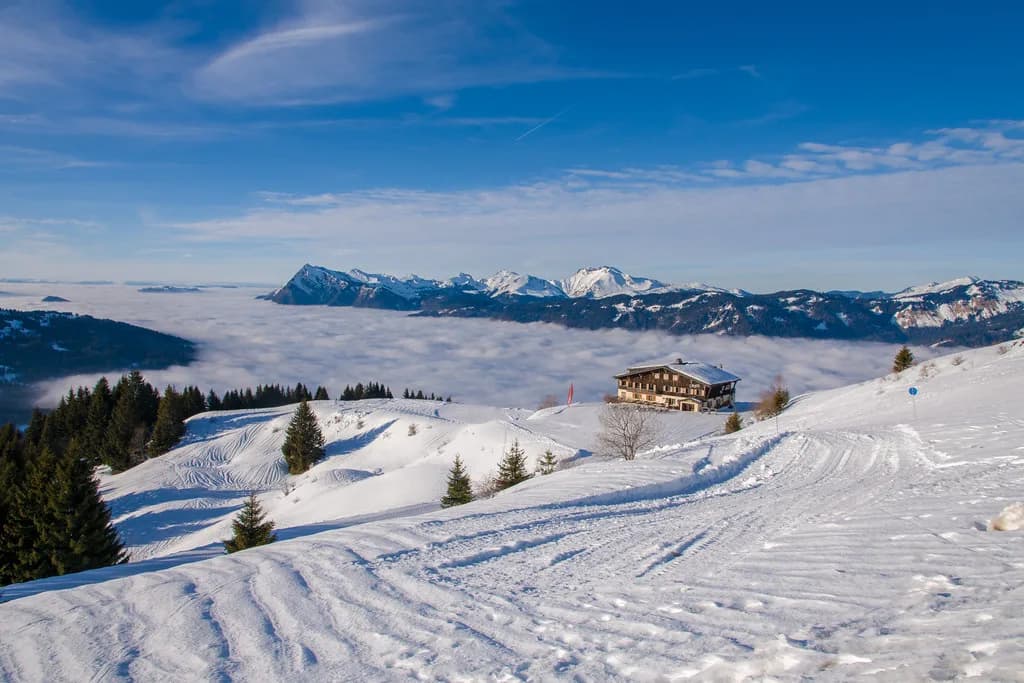
The local slopes immediately above the village are largely tree-lined, which gives you options when the weather closes in and visibility drops higher up. The higher sectors toward Tête des Saix and beyond open into more exposed terrain. Knowing which half of the mountain you are heading for on a given day is the core skill of a Samoëns week.
Altitude context also explains why the village base and the upper station feel like two different resorts. The gondolas are the bridge, covering the vertical in a matter of minutes, and the free ski bus handles the ground-level connection between village accommodation and the lift stations.
The two access gondolas: Grand Massif Express and Vercland
Two cable cars link the village of Samoëns to Samoëns 1600: the Grand Massif Express gondola and the Vercland gondola. Samoëns tourism office recommends the Grand Massif Express for beginners and for skiers with lessons, which makes it the default morning route if you are learning or meeting an instructor. Both lifts make the climb in about eight minutes, so the commute is short whichever you choose.
Treat the two gondolas as different tools rather than duplicates. The Grand Massif Express drops you at the heart of the beginner front and the lesson meeting area, while Vercland gives you a second documented route up from the village, useful when you want to vary your start or avoid the busiest queues. Which one suits you depends on whether your morning priority is the learning zone or reaching the wider network quickly.
Whichever you take, remember that the gondolas are your descent as well. The access lift sits slightly outside the town centre, and you ride it down at the end of the day, so your final run needs to finish at the right station. Factoring that into your afternoon plan avoids a scramble when the lifts are winding down.
Samoëns-local sectors: the beginner front, Chariande and Saix
The Samoëns-local terrain splits into a few recognisable pieces. Samoëns 1600 is the beginner-facing front, with the nursery slopes and easy lifts clustered at the gondola arrivals. Above and beyond it, the Chariande Express chairlift and the runs toward Tête des Saix open up the more ambitious local skiing, including the tree-lined descents back toward the village.
A documented route from the village to Flaine illustrates how the local sectors connect: ride the Grand Massif Express up, take the Demoiselles green run to the Chariande Express chairlift, climb to Tête des Saix at 2,218m, then follow the Silice Malice and Dolomie blue runs down to the Vernant chairlift to reach Flaine. Notice how many separate lifts that sequence involves, because it is a multi-stage journey rather than a single hop across a boundary.
That structure should shape your day planning. If you intend to range into Flaine and back, budget the morning for the crossing and treat the return with the same care, checking when the connecting lifts stop running. If you would rather stay local, the runs above the village and the beginner front can fill a satisfying day without committing to the traverse.
The five linked areas of the Grand Massif
The Grand Massif joins five resort areas: Flaine, Les Carroz, Morillon, Samoëns and Sixt-Fer-à-Cheval, spanning 7,600 hectares. From Samoëns you can work your way into the neighbouring sectors by lift rather than by road, which is the point of buying into the wider pass. The distance between the areas is the constraint to respect.
Skiing across the network genuinely requires lift time. A crossing to Flaine involves the sequence described above, and returning to the Samoëns side before the links close is a real planning consideration. This is why the pass boundary decision and the terrain decision are the same decision: the further your pass reaches, the more of your day you spend travelling between sectors.
For most visitors, ranging across the whole network on one or two days and staying closer to the Samoëns sectors on the others balances variety against travel time. Check the interactive map and the day's lift and piste status before committing to a big traverse, since links can be affected by conditions.
Samoëns Beginner Pass: what it includes and where it stops
The Samoëns Beginner Pass is documented as giving access to Samoëns 1600 and the beginner-area lifts. Its stated inclusions are two round trips on the Grand Massif Express or Vercland gondolas, the Pendant, Château, Babuches and Plateau drag lifts, and the Damoiseaux and Demoiselles chairlifts. Beginner skiing on the Oratoire magic carpet is free.
Read those inclusions carefully, because the pass is built around the local beginner infrastructure rather than the wider network. Two gondola round trips means a defined daily allowance for the access lifts, which suits a learner whose day centres on the nursery slopes and the easiest chairlifts. It does not carry you into the neighbouring resort areas.
If your plan involves exploring beyond the Samoëns sectors once your confidence grows, the Beginner Pass will feel restrictive by mid-week. If your group is genuinely staying on the easy terrain for the whole trip, it maps neatly onto where you will actually ski. Decide which of those describes your party before you buy.
Vill4ges Pass versus Grand Massif Pass
The Vill4ges Pass covers the slopes of Samoëns, Morillon, Les Carroz and Sixt-Fer-à-Cheval, while the Grand Massif Pass adds Flaine on top and covers 265km of piste in total. That is the core boundary decision: whether you need Flaine and the high terrain it opens, or whether four village-linked areas are enough for your week.
The Grand Massif Pass includes everything the Vill4ges Pass covers and extends to Flaine, so it is the more flexible option if you intend to range widely. The question is whether the added area earns its place in your plan, given that reaching Flaine from Samoëns takes real lift time. Strong intermediates who like covering ground and confident skiers chasing higher terrain are the natural audience for the wider pass.
A useful test is whether you expect to spend at least a couple of days on the Flaine side. If yes, the Grand Massif Pass removes the daily calculation. If your group is learning, or happy to rotate between the Samoëns, Morillon, Les Carroz and Sixt sectors, the Vill4ges boundary may match your skiing more honestly. State the inclusions as documented, since pass products and their conditions are set by the lift company.
Beginner provision at Samoëns 1600
Samoëns 1600 is described as one of the largest beginner areas in Haute-Savoie, and the documented infrastructure backs that up. There is gondola access designed to ease the first ride, seven easy lifts, a covered carpet for climbing the slopes, and a concentrated family area with a children's garden, play area and toboggan run. Beginner fun features include the Septisnake and ZiZiPanPan's Myzterious Forest.
The detail that matters for planning is the layout: the learning terrain is concentrated rather than scattered, and there are no stairs to negotiate to reach it, which reduces the faff of the first morning. A dedicated beginner pass exists for this zone. If you are travelling with first-timers, this concentration is the strongest argument for basing yourself at the upper station.
Keep expectations grounded: a beginner area is only as useful as the day's conditions, and lift and piste opening is conditional. The documented provision tells you what exists, not that every lift will run every day. Check the day's slope information before setting out with new skiers.
Ski school logistics and the meeting point
The published meeting point for ski schools in Samoëns is Samoëns 1600, at the arrival of the Grand Massif Express gondola. That single fact drives your morning timing: you need to be up the gondola before your lesson starts, not queuing for it. Build in a buffer on the first day, especially in peak weeks.
Because the meeting point is fixed at the upper station, staying in the village means allowing for the bus or the drive to the gondola before you even join the lift queue. Staying at Samoëns 1600 removes that leg but puts you further from the town. Either way, the gondola ride itself takes about eight minutes, so the variable is the connection at the bottom rather than the lift.
Details such as lesson formats, group sizes and instructor availability are set by the individual ski schools, so check them directly with the school you book. The tourism office publishes the meeting location; the schools publish their own lesson arrangements.
Buying passes: online, delivery and cancellation terms
Samoëns tourism office recommends buying ski passes online, and passes can also be bought at the ticket offices of the Grand Massif Express and Vercland gondolas. Online purchase is encouraged because it lets you sort the booking before you travel, but the ticket offices remain a documented fallback if you arrive without one.
Home delivery is offered for orders placed at least seven days before arrival, which is a concrete cut-off to plan around if you want the pass in hand before you travel. There is also a paid cancellation option that allows free cancellation before your first day on the slopes, and a mechanism that readjusts the pass price if lift service is interrupted during your stay. These conditions are set by the lift company and can change.
The practical sequence is to decide your pass tier first, then your purchase method, then whether the delivery or cancellation terms change your timeline. If you are ordering within the delivery window, plan to collect or buy locally instead. Check the current conditions on the Samoëns.com booking page rather than relying on last season's terms.
Ski bus, lockers and equipment logistics
Free ski bus shuttles connect the centre of Samoëns to the gondolas, which is the practical answer for anyone staying in the village without a car. Find your nearest stop and check the line schedules, since the buses run to their own timetables rather than to your convenience. Building the bus into your morning plan is easier than improvising it.
Ski lockers are available at Samoëns 1600 if you rent your equipment from the documented partner rental shops: Mountain ski shop, Roland Gay Ski Service Ski Set, and Sport 200 – skiloc 1600. That conditional link between lockers and rental provider is worth noting before you assume a locker is included with any rental. If you are not renting from those shops, plan to carry your gear.
Parking is free throughout Samoëns except for the Grand Massif Express car park, which is paid during winter. If you are driving to the gondola each morning, that exception affects your daily cost and your choice of which lift to use. The Vercland route avoids that specific charge, though parking arrangements are worth checking locally.
Contingency planning for lifts, links and conditions
A scheduled season is operational intent, not a promise that every lift, link and piste will open on any given day. Wind, snow and maintenance can all affect what runs, and the cross-network links are particularly worth checking before you commit to a long traverse. Plan your ambitious days with a fallback closer to the village.
The local tree-lined runs above Samoëns are the natural bad-weather alternative, since they offer more shelter than the exposed higher terrain. If the links to Flaine are not running, the Samoëns, Morillon, Les Carroz and Sixt sectors still give you a full day within the Vill4ges boundary. That is one argument for weighting your pass decision toward the terrain you can reach whatever the weather.
Before each ski day, check the day's slope and lift information and the webcams, both published by the resort. Treat those live pages, not last season's records, as your source for what is open now. No guide can tell you in advance what will be running on your dates.
A practical planning sequence for a Samoëns ski week
Start with the base decision: village or Samoëns 1600, weighing town atmosphere against slope-side convenience. Then choose your access gondola habit, defaulting to the Grand Massif Express if you are learning or meeting an instructor and using Vercland when you want an alternative route up. These two choices set the shape of every ski day.
Next, pick your pass tier against your actual ambitions: the Beginner Pass if the trip is about the local learning zone, the Vill4ges Pass if four linked areas are enough, the Grand Massif Pass if Flaine is genuinely in your plans. Then set your purchase timeline around the seven-day home-delivery cut-off if you want the pass before you travel, and check the cancellation terms for your dates.
Finally, sort the ground logistics: ski bus times from your accommodation, locker eligibility if you are renting, and the paid parking exception at the Grand Massif Express. Check the day's lift and piste status each morning before committing to a big traverse. Do the steps in that order and the operational details fall into place around your skiing rather than competing with it.
Plan Your Samoëns ski week around the terrain you will actually use
Samoëns works as a base when you accept the two-level layout and plan around the gondolas, the ski bus and the conditional nature of lift links. The beginner front at Samoëns 1600 is the strongest documented asset for learners and families, while the higher local terrain and the linked Grand Massif sectors reward skiers who are willing to travel across the network.
Match your pass to your real plans rather than to the biggest network, and treat the delivery window and cancellation terms as timeline decisions. If you want a comparison point for how another French resort organises its terrain and passes, the Alpe d'Huez Skiing Guide covers a very different layout.
Before you book, confirm the current pass inclusions, season dates and day-to-day lift status directly with the Samoëns tourist office or the Grand Massif lift company, since those are the details that decide whether your week runs as planned. Plan the structure now and check the operational specifics close to your travel dates.
Explore more Samoens guides
Frequently Asked Questions
Is Samoëns a good ski resort for a full week?
It can be, provided you use the linked network rather than expecting a single large local hill. The Samoëns-local sectors cover a beginner front and tree-lined terrain above the village, and the Grand Massif connection adds Morillon, Les Carroz, Sixt-Fer-à-Cheval and Flaine. A full week usually mixes local days with one or two longer traverses, budgeted with lift time in mind.
Which ski pass do you need in Samoëns?
It depends on how far you intend to roam. The Samoëns Beginner Pass covers Samoëns 1600 and the documented beginner lifts, the Vill4ges Pass covers Samoëns, Morillon, Les Carroz and Sixt-Fer-à-Cheval, and the Grand Massif Pass adds Flaine and the full network. Inclusions and terms are set by the lift company, so check current details before buying.
How do you get from Samoëns village up to the ski area?
Two cable cars, the Grand Massif Express and the Vercland gondolas, connect the village to Samoëns 1600 in around eight minutes. The Grand Massif Express is the recommended choice for beginners and skiers with lessons. Free ski bus shuttles also run from the village centre to the gondolas, and you ride the access lift back down at the end of the day.
Can you ski from Samoëns to Flaine?
Yes, but it is a multi-lift sequence rather than a short hop. The documented route runs from the Grand Massif Express gondola, down the Demoiselles green run, up the Chariande Express to Tête des Saix at 2,218m, then down the Silice Malice and Dolomie blue runs to the Vernant chairlift into Flaine. You need a pass that includes Flaine and enough time to return before links close.
Is Samoëns good for beginners?
Samoëns 1600 is described as one of the largest beginner areas in Haute-Savoie, with gondola access, seven easy lifts, a covered carpet and a concentrated family area. Beginner skiing on the Oratoire magic carpet is free, and a dedicated beginner pass covers the local learning zone. A beginner area still depends on the day's conditions, so check slope and lift status each morning.
Sources
Useful notes for your next ski trip
Optional updates to our Alpine resort guides.
You might also like
Continue reading
More guides you'll find useful