Schladming Skiing: 4-Mountain Area, Passes and Terrain Guide
Schladming skiing explained: the linked 4-Mountain core, wider Schladming-Dachstein sectors, Ski amadé versus local passes, beginner zones and terrain mix.
On this page
Schladming skiing suits groups who want a compact, linked core of four mountains rather than a single hill, and who are happy to decide up front whether they will stay inside that core or range across the wider region. The two choices that shape everything else are your pass boundary and which of the four linked mountains you base yourself near.
The destination sits in Styria, Austria, and the Schladming-Dachstein tourism office describes a Schladming 4-Mountain Ski Area made up of Hauser Kaibling, Planai, Hochwurzen and Reiteralm, with smaller mountains around it. Because the linked core and the wider region are counted differently, this guide separates the two scopes instead of blending them.
If you already know you want a different Austrian region, our alpbach skiing guide and ischgl skiing guide cover alternative bases; otherwise read on for the Schladming decision itself. Everything below distinguishes what operators and the tourism board publish from the judgements you have to make for your own group.
Opening decision: who Schladming suits, and the two choices that decide the trip
The first decision is scope: stay inside the linked 4-Mountain core, or buy into Ski amadé and treat Schladming as one entry point to a much larger network. The Schladming-Dachstein tourism region page states that a Ski amadé pass reaches more than 760 kilometres of piste and 270 lifts across five regions, which is a very different product from a local day ticket tied to one or two mountains.
The second decision is which side of the core you sleep on, because the four mountains are linked but not identical in character. Intermediates and keen piste skiers usually get the most out of the red-heavy middle of the area, while beginners are better served close to a valley-station practice zone.
A useful test when choosing: if your group will realistically spend all week cruising linked pistes and never leave the core, a narrower pass may be sufficient; if anyone wants to range into neighbouring Ski amadé regions, the wider product is the one to price first. Confirm current products and inclusions through Ski amadé, because pass boundaries are commercial decisions that change.
Where Schladming sits and what the destination actually contains
Schladming is a town in Styria, in central Austria, and the tourism board frames the surrounding Schladming-Dachstein region as nine ski mountains with a total of 222 kilometres of piste and 99 lifts. That regional figure is the broadest count and includes the smaller mountains as well as the famous linked core.
The Ski amadé regional page describes the same destination with a notably lower total, around 171 kilometres of piste and 82 lift facilities. Both are official sources, and the discrepancy is unresolved, so treat any single piste total as scope-dependent rather than as a settled fact.
A third framing comes from the Ski Club of Great Britain, which describes the four linked mountains as a 123-kilometre network served by 44 lifts. That is a count for the 4-Mountain core specifically, not for the whole Schladming-Dachstein region, and the page notes its statistics derive from an external aggregator.
Practically, the labels matter more than the arithmetic. When you read a piste figure for Schladming, check whether it refers to the linked core, the wider region, or the whole Ski amadé network, because each describes a genuinely different amount of terrain.
The 4-Mountain core: Hauser Kaibling, Planai, Hochwurzen and Reiteralm as one linked sector
The core is the reason most people choose Schladming: four mountains that connect into a single ski circuit. The tourism board lists Hauser Kaibling, Planai, Hochwurzen and Reiteralm as the four linked mountains, and the Ski amadé regional page describes them as the heart of the destination with wide carving slopes and sporty descents.
The four mountains are not interchangeable in character. The Ski Club notes that most of the terrain suits intermediates, with beginner facilities particularly at Rohrmoos, near the Planai and Hochwurzen side, while advanced skiers find limited challenges unless snow cover opens up more technical lines.
Basing yourself close to one of the four mountains reduces daily faff, because valley stations differ and the linking lifts only help if you are already on the circuit. Families whose priority is easy beginner terrain may prefer the Rohrmoos side, while groups chasing linked cruising often base closer to the Planai or Hauser Kaibling access points.
The wider Schladming-Dachstein region and its smaller mountains
Beyond the linked core, the region holds smaller mountains that change the feel of a trip. The tourism board lists Fageralm, Galsterberg and Ramsau among the smaller areas, each with its own valley access and a more contained scale.
Two further mountains, the Riesneralm and the Planneralm, sit on a different pass product, the Schneebären Card. Both are described as quieter, more contained alternatives to the major areas, and the Riesneralm lists its own children's ski area at valley level.
These smaller areas matter mainly if you want a calmer day or are travelling with very young skiers, but they are not part of the linked core. Check which pass covers each one before planning a day there, because the Ski amadé and Schneebären products do not automatically include the same mountains.
Reading the terrain mix: what 92 km blue, 115 km red and 15 km black means for your group
The tourism board breaks the region-wide piste total into 92 kilometres of blue, 115 kilometres of red and 15 kilometres of black. That distribution tells you the destination is weighted toward intermediate cruising, with a modest share of genuinely steep terrain.
The Ski Club frames the same core differently, suggesting roughly 38 percent beginner, 55 percent intermediate and 7 percent advanced terrain, and warns that low altitude means snow quality can suffer in mild spells. Combined, the two sources point to an intermediate-first mountain, not a freeride destination.
For planning purposes, ask whether your strongest skier will be satisfied by a red-heavy area and whether your weakest is comfortable on blues that run across linked mountains rather than staying on one gentle slope. If you have a large expert cohort, this terrain mix is a reason to look elsewhere.
Beginner provision and children's areas, and what is documented at valley level
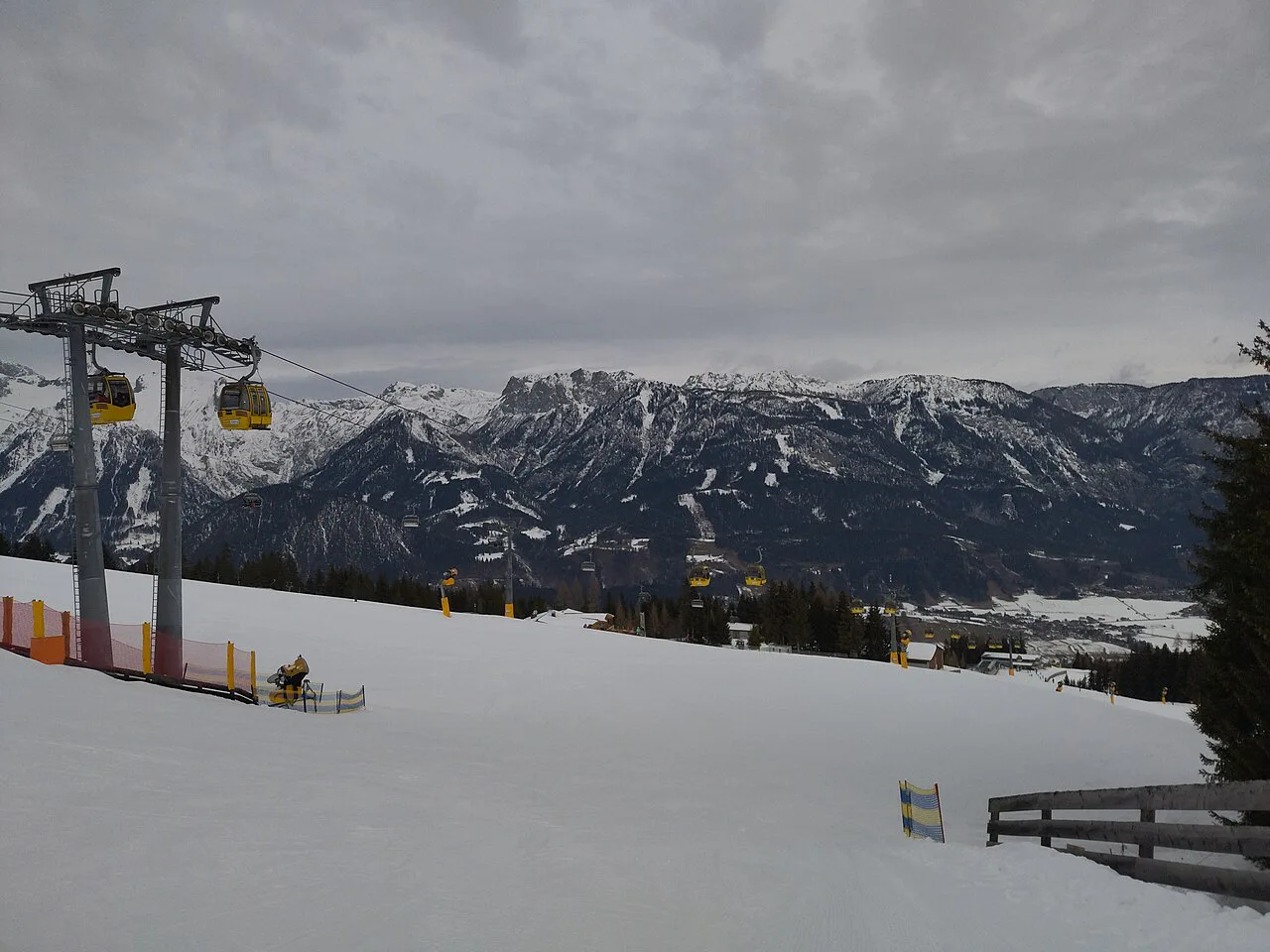
The region documents several children's areas at valley-station level, which is a meaningful detail because it means a beginner can start skiing without riding a mountain lift first. The tourism board names the Wollis Kids Park at the Hauser Kaibling valley station and Kaliland in Ramsau, among others.
The same page states that for the 2026/27 winter season all children up to the age of six ski free across the four linked mountains and several smaller areas, and that a free visit to the Dachstein Glacier is included in that offer. This is a published operator offer for a named season, not a permanent policy, so check the terms for whatever season you are actually booking.
The Ski amadé regional page adds that spacious children's areas and practice zones with magic carpets and playful courses support first turns, while professional ski schools guide beginners. What that means for you is to ask a specific school, such as one of the local ski and snowboard schools in Schladming-Dachstein, which beginner zones and meeting points they actually use before booking lessons.
Ski amadé versus local and Schneebären products: the pass-boundary decision
The pass decision is a boundary question first and a price question second. The tourism board states that the Ski amadé product covers more than 760 kilometres of piste and 270 lifts across five regions, whereas the Schneebären Card and other local products cover subsets of the Schladming-Dachstein area.
If your group's plan is to stay on the linked core and never leave it, a narrower product may be the better value; if anyone intends to explore other Ski amadé regions during the week, the wider pass is the one to price. The tourism board lists two, three-day, five-day, and '5 in 7 days' options among the multi-day products, which suggests the pass system is designed around a range of trip lengths.
Check the specifics of whichever product you shortlist, because pass inclusions, age brackets and validity periods are commercial terms that Ski amadé revises year to year. The pass boundary that looks obvious on a map is not always the same as the pass boundary in the ticket shop.
Ticket mechanics that change the price you pay: validity windows and advance booking
Schladming ticket pricing is not a single number, because the tourism board publishes several distinct products and validity windows. For the named season beginning 19 December 2026 and running until 26 March 2027, it lists three-hour tickets, a one-day ticket, and tickets valid from noon, each with online early-booking prices alongside ticket-office prices.
Those published prices apply to that specific season and to the named products, and cannot be carried backward or forward to other years or other pass types. If you are booking a different season, treat those figures as illustrative of the pricing structure rather than as a budget figure.
Ski amadé advertises an online early-booking bonus and says tickets can be loaded onto an existing KeyCard or collected from a pick-up machine. Age definitions matter here too, because the published brackets are set by birth year and youth and child rates require photo identification; compare the current age table with your group before you buy.
Night skiing on the Hochwurzen as a separate, separately ticketed session
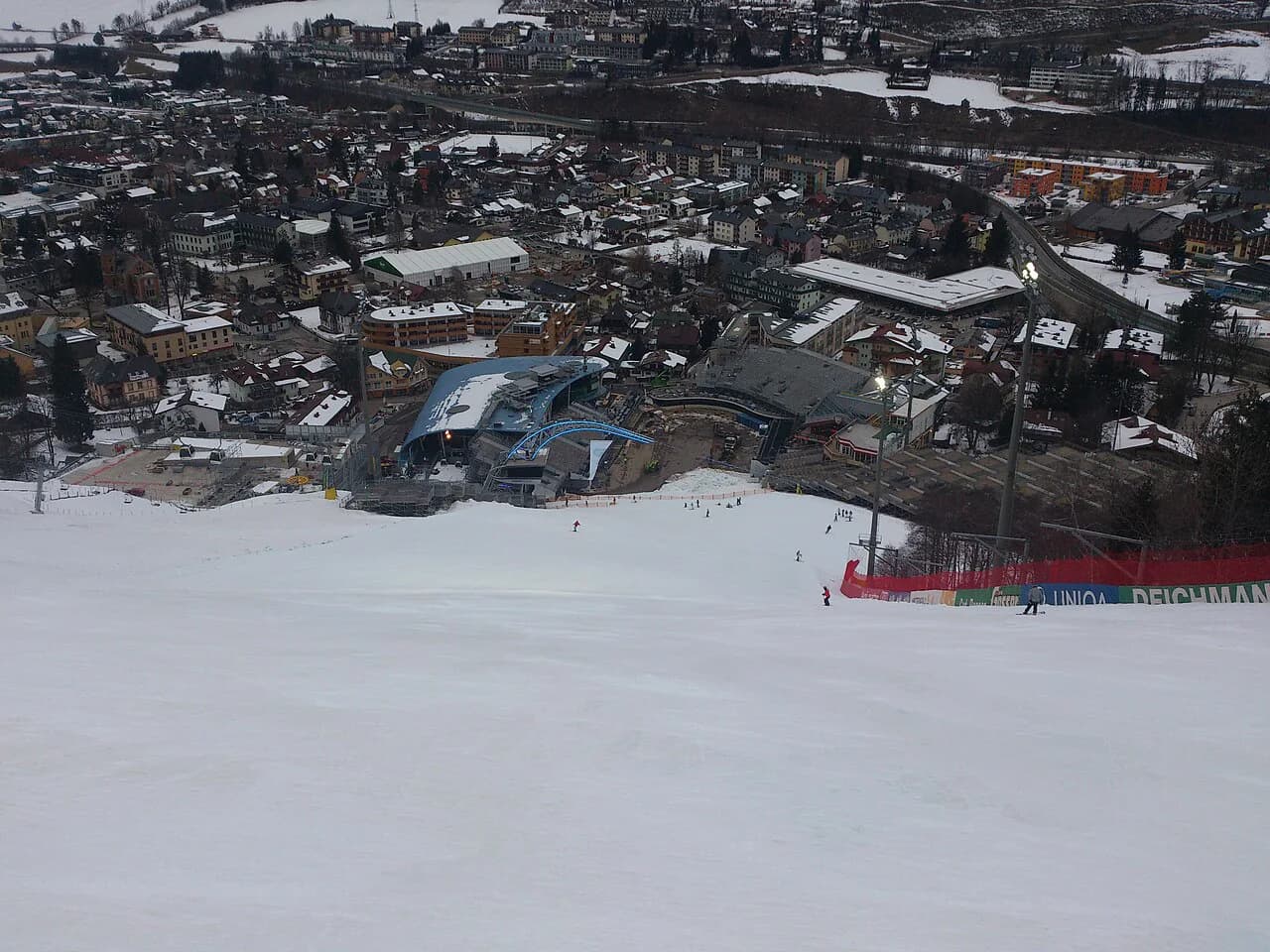
Night skiing at Schladming is an add-on, not part of the standard day. The tourism board states that the Hochwurzen offers evening skiing, with piste number 32 freshly groomed every evening from Monday to Saturday and open until 11 pm.
It requires its own evening ticket, but holders of a valid Planai and Hochwurzen day pass get a 20 percent discount on that evening ticket. If you want a night session, factor the extra ticket into your budget and plan it as a separate evening rather than expecting your day pass to cover it.
Ski schools and ski hire: what is documented and what to verify per operator
The tourism board confirms that ski and snowboard schools operate in the region and that ski and snowboard rental shops are available, described as well equipped for a range of needs. What it does not publish is a schedule of lesson meeting points, group sizes, or language options for individual schools.
For lessons and hire, contact the specific school or shop directly and ask about meeting points, group ratios, equipment categories, and cancellation terms when you enquire. Names of children's areas or schools do not tell you what a particular ski school or rental shop provides, and inclusions should be checked rather than taken for granted.
It is also worth asking where your chosen school actually meets when the mountains are busiest, because the location of the meeting point affects how early you need to leave your base. That is an operational detail only the ski school itself can answer.
Season windows by mountain and their operational status
Ski amadé publishes expected 2026/27 season windows by mountain. Hauser Kaibling is listed from 28 November 2026, Planai and Hochwurzen from 4 December, Reiteralm from 20 November, and Fageralm from 18 December, with most running to early April 2027.
The tourism board gives a more detailed picture: some mountains open as early as November depending on snow, while many get underway in late November or early December, and it separates mountains with fixed published dates from those opening 'as snow conditions permit'.
These are expected, conditional windows rather than promises that every lift, link or piste will be open. A scheduled season start means a mountain intends to operate from that date; it does not guarantee that the connecting runs between mountains, or all lifts, will be open on day one.
For planning around a specific week, the useful check is Ski amadé's live opening information rather than the season table alone, because weather and snow conditions affect what actually runs. Book flexible travel where you can, and recheck in the week before departure.
Practical planning sequence for a Schladming ski trip
Start with the scope decision: will you stay inside the linked 4-Mountain core or buy a Ski amadé pass that reaches across five regions? That single choice determines which pass products to price, and it should come before you choose a base.
Second, match your group to the terrain. With 115 kilometres of red against 92 of blue and 15 of black across the whole region, this is an intermediate's mountain more than an expert's; if you have a mixed group, check that the strong skiers are content with red-heavy linked cruising.
Third, pick a base close to the valley access that matches your plan: Rohrmoos if beginner terrain is the priority, or another of the four mountains if linked cruising is the goal. Fourth, check season windows for your specific week and confirm opening status closer to departure, since these are conditional operations.
Finally, book lessons and hire through named ski schools and rental shops after checking their meeting points and inclusions, and buy passes through the official Ski amadé ticket shop so you can take advantage of documented advance-booking terms. Nothing in this sequence substitutes for what Ski amadé publishes for your chosen week.
Publication blockers and open questions for follow-up spokes
One unresolved issue is the discrepancy between the two official sources on piste and lift totals: 222 kilometres and 99 lifts on the tourism board's page, against around 171 kilometres and 82 lifts on the Ski amadé regional page. Neither should be presented as the single correct figure without stating its scope, and a follow-up could clarify what each count includes.
Another open question is how the narrower local and Schneebären products map onto the individual mountains, since the tourism board names the products but does not spell out every inclusion on the pages reviewed. Anyone planning to buy a local product should check the current inclusion list directly.
A third gap is pass-inclusion detail for the smaller mountains, which affects whether a day at the Galsterberg or the Riesneralm is covered by the pass you already hold. These are questions for the lift companies and the Schladming-Dachstein tourism office, not for inference from a mountain's name or reputation.
Plan Your Visit
Schladming skiing comes down to two decisions: whether you stay inside the linked 4-Mountain core or buy into the Ski amadé network, and which mountain you base yourself near. Get those right and the region's red-heavy, intermediate-friendly terrain works well for a group of mixed-ability piste skiers.
Confirm pass products, ticket validity, and season windows with Ski amadé before you commit, and remember that published opening dates are expected operations rather than guarantees. If you want to compare the decision against another Austrian base, our alpbach skiing guide and ischgl skiing guide offer alternative framings, and our Kaprun Ski guide shows how a glacier-backed resort handles the same pass-scope question.
Explore more Schladming guides
Frequently Asked Questions
How many kilometres of piste does Schladming-Dachstein have?
The tourism board puts the Schladming-Dachstein region at 222 kilometres of piste and 99 lifts, while the Ski amadé regional page states around 171 kilometres and 82 lifts. The two official sources disagree, and the Ski Club gives a separate 123-kilometre figure for the linked 4-Mountain core specifically. Treat any total as scope-dependent and check which area it covers.
Which mountains make up the Schladming 4-Mountain Ski Area?
The linked core comprises Hauser Kaibling, Planai, Hochwurzen and Reiteralm. The tourism board describes them as directly connected, and the Ski amadé regional page calls them the heart of the destination. Smaller mountains such as Fageralm, Galsterberg and Ramsau sit outside this linked group.
Do you need a Ski amadé pass to ski in Schladming?
Not necessarily. The Ski amadé product covers more than 760 kilometres of piste and 270 lifts across five regions, but local and Schneebären products cover subsets of the area. If you intend to stay inside the linked core, a narrower product may suffice; if you plan to explore other Ski amadé regions, price the wider pass. Check current inclusions.
Is there night skiing in Schladming-Dachstein?
Yes. The tourism board states that the Hochwurzen offers evening skiing on piste number 32, freshly groomed from Monday to Saturday and open until 11 pm. It requires its own evening ticket, though holders of a valid Planai and Hochwurzen pass get a discount. Check current operating details and ticket terms.
When does the Schladming ski season start?
The 2026/27 start dates are published by mountain, ranging from late November to mid-December, with Reiteralm listed earliest at 20 November and Fageralm latest at 18 December. The tourism board notes that some mountains open as early as November depending on snow, while others open as conditions permit. These are conditional operations, not guarantees.
Are ski schools and ski hire available in the region?
The tourism board confirms that ski and snowboard schools operate in the region and that rental shops are available. It does not publish lesson meeting points, group sizes or equipment categories for individual operators. Contact specific schools and shops directly to confirm what they provide before booking.
Is Schladming good for beginners?
The region documents several children's areas and practice zones at valley-station level, including Wollis Kids Park at Hauser Kaibling and Kaliland in Ramsau, which means beginners can start without riding a mountain lift first. The terrain mix is weighted toward blue and red runs. Confirm which beginner zones a specific ski school uses before booking lessons.
What is the terrain mix like for advanced skiers?
The regional piste total includes only 15 kilometres of black runs against 115 kilometres of red, and the Ski Club notes limited challenges for experts and warns that low altitude can affect snow quality in mild spells. Advanced skiers should expect a red-heavy area rather than a steep or freeride-focused destination. Check current conditions.
Sources
Useful notes for your next ski trip
Optional updates to our Alpine resort guides.
You might also like
Continue reading
More guides you'll find useful