Alpe d'Huez Snowboarding Guide: Parks & Terrain Tips
Plan a snowboarding trip to Alpe d'Huez with a level-by-level look at five snowparks, the boardercross courses, lift access and linked sectors.
On this page
Alpe d'Huez is one of the few French resorts where freestyle is treated as a set of distinct zones rather than one flagship park. The ski area publishes five snowparks and two boardercross courses scattered between Alpe d'Huez, Montfrais and Villard-Reculas, graded from XS features for children to a 900 m expert line. That spread matters when you plan a trip: picking the right park and the right base saves you a morning of traversing.
This guide walks through the terrain figures, each park by level, lift access, the linked villages that share the lift pass, and the practical calls on passes, schools and hire. Where a figure or date changes season to season, it points you to the organiser rather than inventing a number.
Why Alpe d'Huez Suits Snowboarders
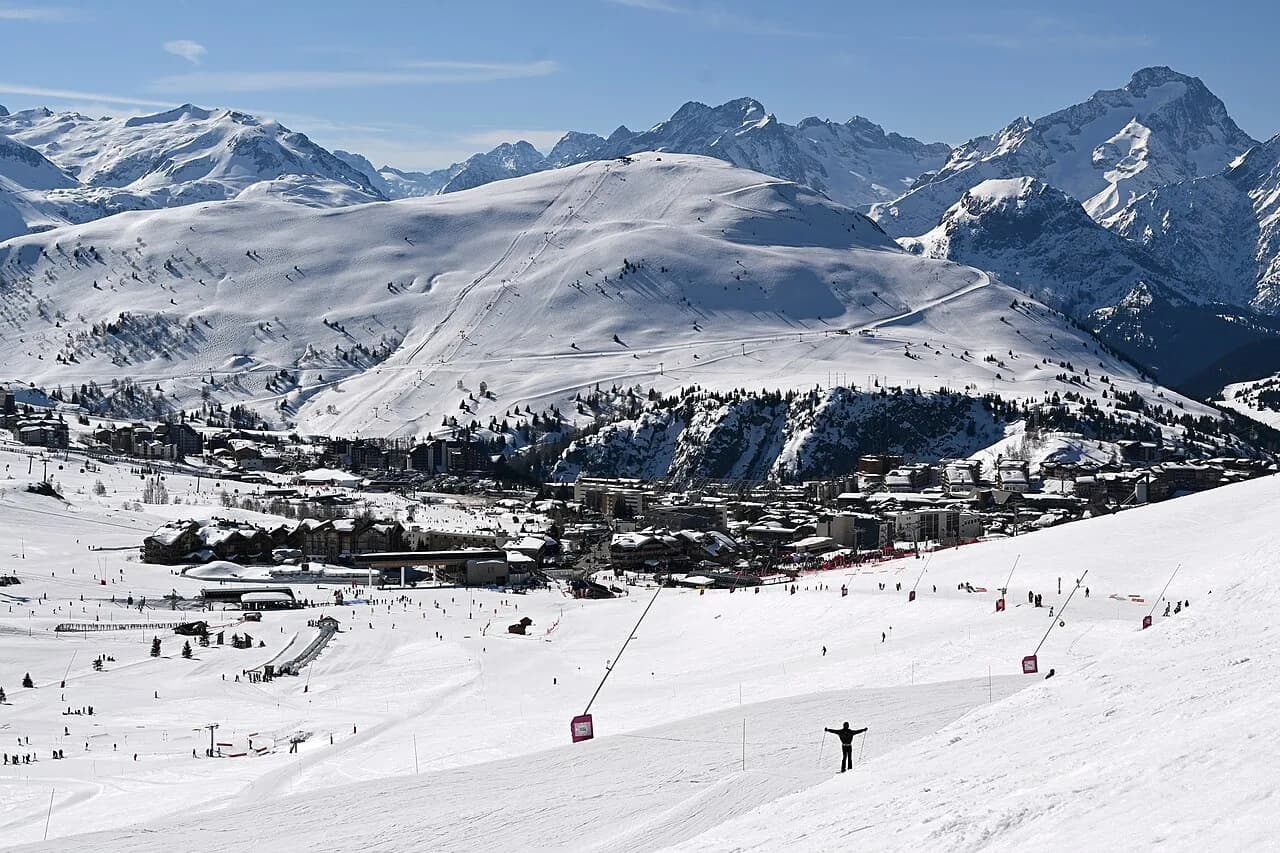
The headline geometry works in a snowboarder's favour: roughly 2,000 m of vertical between the village and Pic Blanc at 3,330 m, with long descents you can link without constant lift changes. The area faces south, which means bright, softer snow on many runs and firm early-morning pistes after a clear night. That combination of vertical and sun is why riders base here for a week rather than a day.
Freestyle riders get structure rather than a single park. The official snowpark pages list graded zones from XS to L/XL plus dedicated boardercross courses, so a group with mixed ability can ride the same sector at different levels. The trade-off is that the parks are not clustered in one place, so you need to read the piste map before deciding where to start each day.
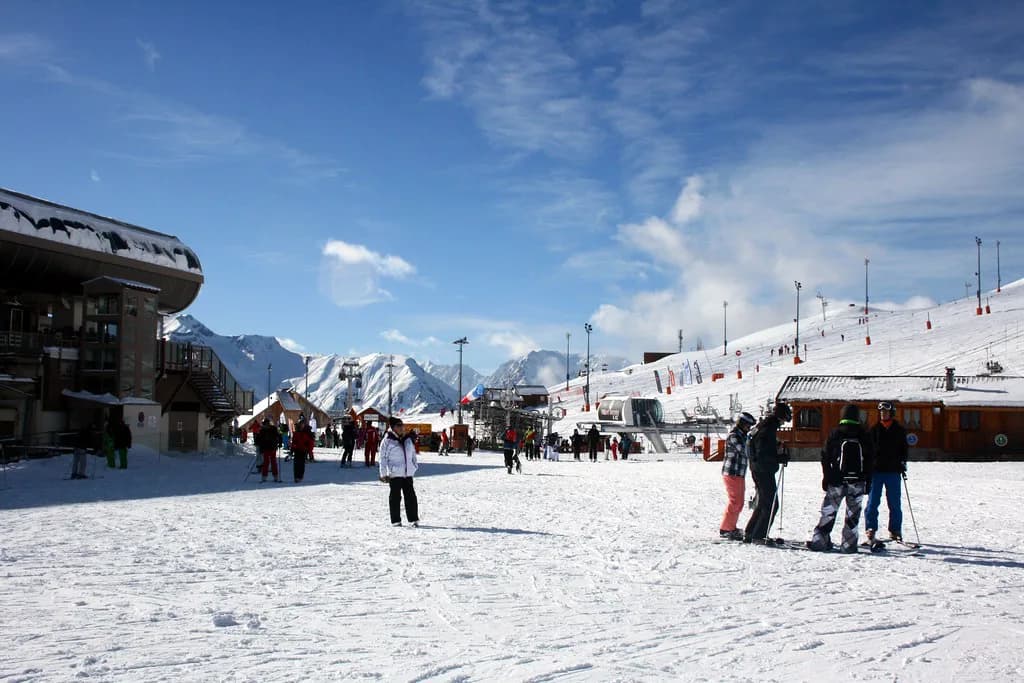
Off the snow, the resort is a full town at 1,860 m with a compact centre, which keeps apres and equipment logistics simple. Villages lower down offer quieter bases with their own lift connections into the same domain.
The Ski Area at a Glance: 250 km Between 1,300 and 3,330 m
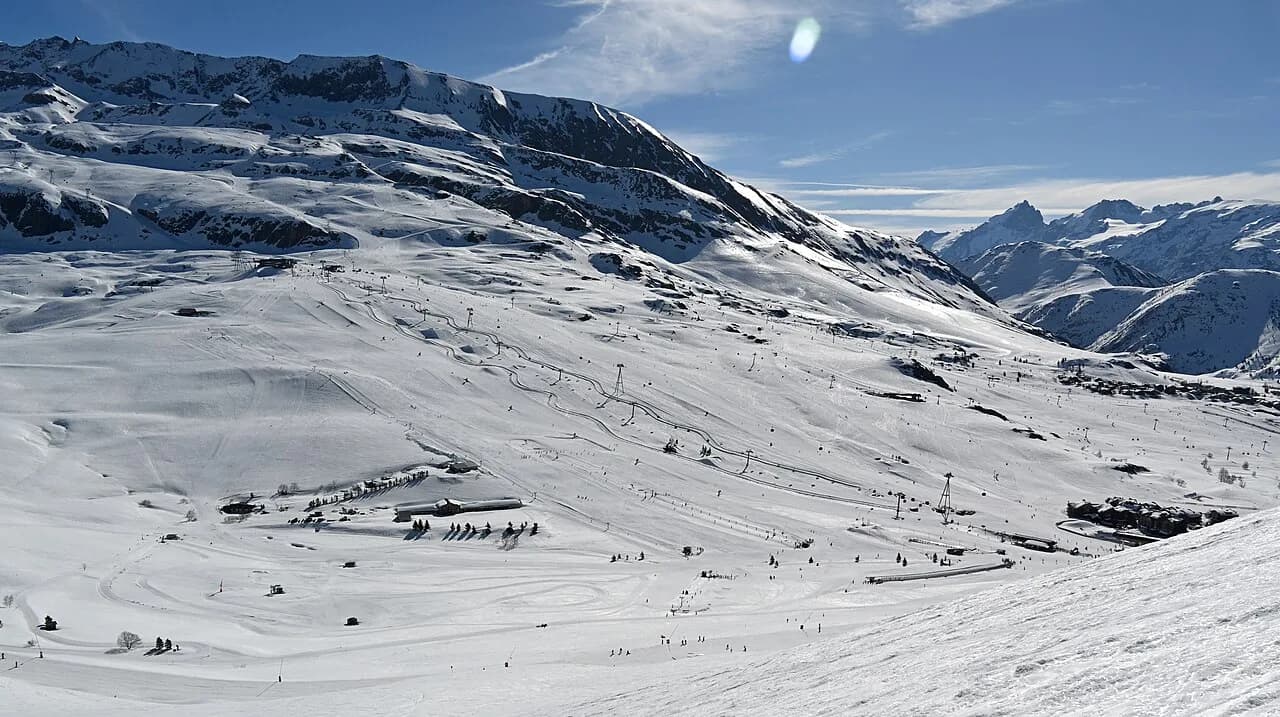
The official piste map puts the ski area at 250 km of slopes served by 111 marked pistes: 34 green, 31 blue, 30 red and 16 black. Altitude runs from about 1,300 m at the lowest lift points up to 3,330 m at Pic Blanc. Those numbers describe a genuinely large domain where a week of riding still leaves runs unvisited.
For riders, the useful consequence is variety of gradient rather than just distance. Green and blue terrain is concentrated around the village sectors and Montfrais, while the long reds and blacks fall from the Grandes Rousses and Pic Blanc side. La Sarenne, billed as Europe's longest black run, is the obvious target for confident riders on a fresh-legs day.
Do not expect every sector to be equally quick to reach. The domain links five base areas, and crossing it takes real lift time, so plan your day around one or two sectors rather than chasing the whole map. The resort's own maps separate the beginner zones, fun slopes and pedestrian routes, which helps you avoid riding into a learning area by mistake.
Snowparks by Level: XS, S, M, L and XL
The grading is straightforward. XS covers first features for children and beginners, S adds boxes and small kickers for riders with basics, M brings jumps and rails, and L/XL is the challenging terrain for experienced freestylers. The resort publishes this ladder so you can pick a zone honestly rather than defaulting to the biggest park on the hill.
Most riders will spend the week in the S and M range, moving up as confidence grows. The XS parks are deliberately small in scale, with mini boxes and gentle bumps, which makes them good places to learn how a park flows without pressure. If your group mixes a first-timer with a confident park rider, split the morning and meet for lunch.
The expert end is concentrated in the Stade sportif des Jeux, described as the dedicated freestyle area for experienced riders. Its features are large and technical, so it rewards riders who already have their basics dialled. Checking the day's line-up and conditions before committing to a park session is sensible, especially early in the season.
Where to Find Each Snowpark
Kids Park des Sagnes sits in the Grandes Rousses sector and is reached by the Sagnes drag lift, with very small bumps, mini boxes and beginner jumps. T-Park is in the Montfrais sector near the Montfrais chairlift and is aimed at families and young riders. Both are the right first stop if you are introducing someone to a park.
For the S level, Bergers Snowpark in the Bergers sector has more pronounced bumps, wider boxes and accessible features for practising first tricks. Montfrais Snowpark, accessed via the Myrtilles slope, offers varied and progressive features for riders extending slides and rotations. Having two S-level parks in different sectors lets you pick the quieter side of the resort.
Vallons Snowpark in Villard-Reculas is the most complete single spot, with S, M and L lines, a spread of features and its own boardercross course. It is reached via the Signal Telemix, Villarais chairlift and Petit Prince drag lift. If your group is spread across levels, Vallons lets everyone ride together from one base.
Stade Sportif des Jeux: The Expert Line and Competition Closures
The Stade sportif des Jeux holds a 900 m expert line with tables of 12 to 25 m, which puts it firmly in the L/XL bracket. Access is from the Grandes Rousses sector via the Jeux Telemix, or from the Bergers sector via the Romains chairlift. That two-sided access is useful: you can approach from whichever sector you are riding.
The area also hosts competitions and training sessions, and public access is prohibited while those are running. The practical move is to check opening conditions for the Stade before building a day around it, particularly at peak holiday weeks when events cluster. If it is closed, Vallons and the S-level parks remain open options.
Boardercross Courses for Fun and Technique
Two boardercross courses run within the ski area, with the one at Vallons Snowpark the most clearly documented. They add bumps, whoops and banked turns, which make them a good way to sharpen edge control and line choice without committing to a full park session. Riding them with friends turns technique work into something closer to a race.
Treat boardercross as a group activity rather than a solo drill. The courses suit riders comfortable at S level and above, and they are usually a better use of an afternoon than repeating the same park line. Check that the course is open on the day, since features can be pulled or reshaped.
Linking Sectors: Alpe d'Huez, Oz-en-Oisans, Vaujany, Villard-Reculas and Auris-en-Oisans
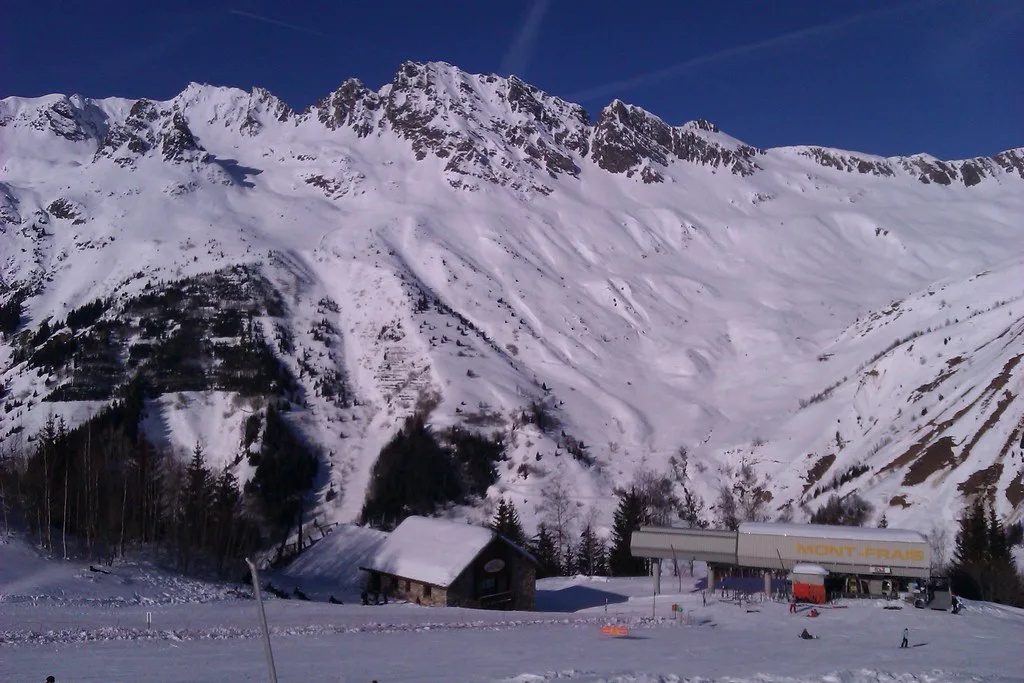
Espace Alpe d'Huez joins five base areas in one lift-pass domain: Alpe d'Huez at 1,860 m, Oz 3300 at 1,350 m, Vaujany at 1,250 m, Villard-Reculas at 1,500 m and Auris-en-Oisans at 1,600 m. They are connected by lifts rather than by road transfers, so you can ride between them in a day. Choosing where to sleep is therefore a decision about character and access, not about being cut off from the domain.
Villard-Reculas is the natural base for Vallons Snowpark and its S to L lines, and it is quieter than Alpe d'Huez village. Vaujany and Oz suit riders who want a calm village but still want the full domain on their pass. Staying in Alpe d'Huez itself puts you closest to the largest choice of bars, shops and hire branches.
Auris-en-Oisans sits at the eastern edge and is the most removed, which makes it a poor choice if the parks are your priority but a good one for quieter piste time. Wherever you base, allow a proper hour for linking sectors rather than expecting a quick hop, and study the connections before you set off.
Which Sectors Suit Which Snowboarding Ability
First-time and early riders are best served by the village-level green and blue zones and by the XS parks at Sagnes and T-Park. The resort's beginner map marks the learning areas and green and blue runs, so you can keep sessions short and repeatable. Keep beginners off the long Pic Blanc runs until they are linking turns comfortably.
Intermediate riders can stretch across most of the domain, using the S-level parks at Bergers and Montfrais to build park skills and the long blues and reds for mileage. Confident riders should target the Grandes Rousses side, the black runs including La Sarenne, and the Stade sportif des Jeux. Freestyle specialists can base themselves around Vallons and Jeux without needing the whole domain every day.
Lift Passes: What to Buy and Where
Passes are sold in durations from one to ten days, with rates falling the longer you ski, and the resort advertises a family deal where four or more people including two children ski at the child rate when booking at least three days before the first ski day. A weekend product is available for Saturday and Sunday if booked before Thursday midnight, and there is a dedicated adaptive-skiing pass. All of these are sold at the ski-pass offices rather than online only.
Prices shown by the resort are starting prices and change by season and date, so check the official pass page for your week before you budget. A useful detail for groups with beginners: ESF notes that under-fives ride free once an access card is collected at the lift office with proof of age and a photo, and that beginners should not buy a pass before the instructor's advice.
If your group includes a mix of abilities, resist the urge to buy everyone the full-domain pass on day one. ESF recommends an initiation package covering all terrain except Pic Blanc and Marmottes 3 for snowflake and first-star levels, and a progression package for the higher levels. The packages are six-day products and stay valid all day, including outside half-day lessons.
Ski and Snowboard Schools: ESF and ESI Options
ESF Alpe d'Huez runs private ski and snowboard lessons in formats from one hour to a full day, including a lunchtime slot when the slopes are quieter. Bookings are priced by format and season, and the school publishes timings that shift late in the season, so confirm your slot when you reserve. It is the larger of the two schools and has meeting points at Grandes Rousses and Bergers.
ESI Alpe d'Huez is the smaller, family-run alternative, offering private ski and snowboard lessons plus group lessons for children aged eight to twelve. Its appeal is a quieter, more personal setup rather than a big-volume programme, and it arranges preferential rates on equipment hire close to its meeting point. For a snowboarder who wants continuity with one instructor, either school can work; compare formats before booking.
Neither school provides equipment, so arrange boards and boots separately before your first lesson. Book private lessons early for Christmas and February weeks, when instructors fill up first.
Equipment Hire Around the Resort
Hire shops cluster in Alpe d'Huez village and around the main lift bases, and ESI offers preferential rental rates near its meeting point at the foot of the lifts. Booking boards and boots before you travel is the low-stress option in peak weeks. Bring your own boots if you can, since fit is the usual reason a rental day goes wrong.
For park days, ask specifically for a freestyle-friendly setup rather than a generic all-mountain board. Shops in resort understand the difference and will adjust stance and edges if you explain what you are riding.
Getting to Alpe d'Huez and Getting Around Without a Car
Most riders arrive by air or rail and transfer in. Grenoble is the closest major airport, with Lyon and Geneva as longer but well-served alternatives, and rail connections run to Grenoble for onward road transfer. The resort publishes routes and practical arrival information, so check the current options before booking flights. For the wider picture on sectors, passes and booking decisions, the Alpe d'Huez Skiing Guide covers the ground this article does not.
Once in resort, lifts and shuttles cover the main bases, and the resort's own information points to lift and shuttle options for getting around without a car. Staying in Alpe d'Huez village means most things are walkable; staying in Villard-Reculas or Auris makes you more dependent on the lift network and shuttles. Weigh that against the quieter base each offers.
If you drive, pre-book parking, since village spaces are limited in peak weeks. The resort lists car parks and arrival guidance for each base.
Snow Surety and Season Timing for Snowboarders
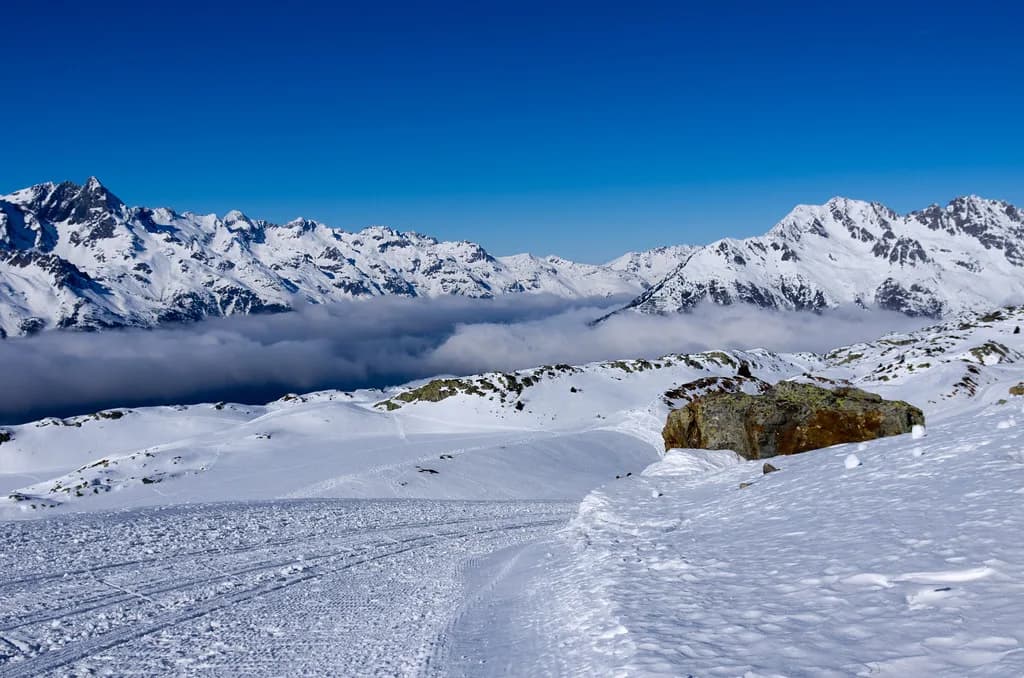
Altitude is the main defence here: the top station at 3,330 m and the mass of terrain above 2,000 m give Alpe d'Huez a long season, and snowmaking and grooming are standard across the main sectors. Early and late season the lower runs back into the villages are the first to suffer, so plan park days higher up. The resort has not published fixed opening and closing dates for the coming winter, so check the official site before booking travel.
The trade-off is sun versus snow. The south-facing aspect gives bright days and softer snow, but it also means freeze-thaw cycles, with firm mornings and slushy afternoons in mild spells. Riding early and taking a long lunch is a sensible pattern in spring.
Practical Tips for a Snowboarding Trip
Decide your park plan before you buy a pass. If you are spending most of the week at Vallons and in Villard-Reculas, staying in that village removes daily lift-linked commuting. If you want the Stade and the long descents, base in Alpe d'Huez and take the Jeux Telemix or Romains chairlift.
Download the resort app for live lift and slope status, and check opening conditions for the Stade sportif des Jeux on event days. Carry a small pack for layers, since temperature swings between the village and Pic Blanc are large. Finally, book lessons and hire before you travel in holiday weeks, when both fill quickly.
If you are comparing French freestyle resorts, a look at how another area organises its parks can sharpen your choice. The approach to park grading and lift access differs notably between resorts, and our Flaine Snowboarding Guide shows how a single flagship park model compares with Alpe d'Huez's scattered zones.
Plan Your Snowboarding Trip
Alpe d'Huez rewards riders who plan around sectors rather than trying to cover the whole 250 km. Pick your park level honestly, match your base to the zones you will ride most, and buy the pass duration that fits your week.
Sort passes, lessons and hire before travel, then check the day's lift and park status each morning. That routine leaves your energy for the riding, which is the point of the trip.
Frequently Asked Questions
Is Alpe d'Huez good for snowboarding?
Yes. The resort publishes five snowparks graded from XS to L/XL and two boardercross courses, spread across the linked sectors, plus 250 km of pistes and around 2,000 m of vertical. The main caveat for riders is that the parks are not clustered together, so plan each day around one sector.
How many snowparks are in Alpe d'Huez?
The ski area lists five snowparks: Kids Park des Sagnes, T-Park, Bergers, Montfrais and Vallons. There are also two boardercross courses, and the Stade sportif des Jeux holds a separate 900 m expert line.
Where are the beginner snowparks in Alpe d'Huez?
Kids Park des Sagnes in the Grandes Rousses sector, reached by the Sagnes drag lift, and T-Park near the Montfrais chairlift are the two XS-level areas. Both use small bumps, mini boxes and beginner jumps for first freestyle steps.
What lift pass do snowboarders need in Alpe d'Huez?
Any full-area pass covers the parks and linked sectors, and durations run from one to ten days with rates falling the longer you ski. Beginners should wait for their instructor's advice before buying, and under-fives ride free with an access card collected at the lift office.
Can you snowboard from Alpe d'Huez to Les Deux Alpes?
No. Les Deux Alpes is a separate ski area and is not linked by lift to Alpe d'Huez. Within Alpe d'Huez itself, the linked villages of Oz-en-Oisans, Vaujany, Villard-Reculas and Auris-en-Oisans are reachable on one lift pass.
How snow sure is Alpe d'Huez for snowboarding?
The ski area reaches 3,330 m at Pic Blanc and most terrain sits above 2,000 m, which supports a long season with snowmaking on the main sectors. Lower runs back to the villages are the first to weaken early and late in the season, so check the official opening dates before booking.
Sources
Useful notes for your next ski trip
Optional updates to our Alpine resort guides.
You might also like
Continue reading
More guides you'll find useful