Les Deux Alpes Skiing: Which Area and Pass to Choose
Plan a Les Deux Alpes skiing trip with a clear look at the resort's seven ski sectors, lift-pass structure, beginner provision, lessons and equipment hire.
On this page
Les Deux Alpes sits in the Oisans area of the Isère department, in the Écrins massif, and it is a resort where the whole mountain is served as one lift network rather than several separate domains. That matters for trip planning because your group can spread across beginner slopes and high-altitude runs without regrouping at a road or a separate pass gate. The operator's own material points to a single ski area organised into named sectors, which is the most useful way to think about the resort before you book anything.
The resort's official season window is scheduled for 28 November 2026 to 2 May 2027, and that is a conditional plan rather than a promise that every lift, link or piste will run on any given day. Sector altitudes run from a snow front at 1,650 m up to glacier terrain at 3,600 m, with mid-mountain sectors around 2,100 m, 2,400 m and 2,600 m between them. Treating those altitudes as a menu of separate areas, each with its own terrain and access, gives you a much better planning tool than a single overall figure.
This guide covers the sector structure, the lift-pass products and their boundaries, beginner provision, lesson meeting arrangements and equipment hire provision, then closes with a decision sequence for choosing the resort. It deliberately avoids accommodation, nightlife and off-piste routes, because those are separate decisions with separate guides. The aim is to get you from an idea of the resort to a shortlist of passes and bookings you can actually make.
Why Les Deux Alpes Suits a Ski Trip
The strongest structural argument for Les Deux Alpes as a ski-trip base is that almost everything is reachable from a single lift network, and the resort describes the area as organised into seven sectors rather than disconnected zones. That means a group with mixed abilities can start together at resort level and separate as the day goes on, meeting again at the bottom without navigating a separate valley or a second lift company. For groups that lose time to logistics, that layout is often worth more than a few extra kilometres of piste.
The resort's position in the Oisans region, within the Écrins massif, puts it in the Isère Alps, with a village base at 1,650 m and lift access climbing towards 3,600 m at the top of the network. That vertical range is the reason the resort appears on shortlists for both first-time skiers and advanced skiers in the same party. The practical consequence is that you can match different members of a group to different sectors instead of compromising on a single area.
Because the official tourism material describes the mountain sector by sector rather than through one headline statistic, be cautious with any single piste count or kilometre figure quoted elsewhere. Skis-advice pages often present aggregate totals, but the primary source captured for this guide does not confirm a global piste count or total distance. Use the official sector structure to plan, and treat other totals as marketing until you see them confirmed in resort material.
How the Ski Area Is Organised: From Snow Front to Glacier
The official sector breakdown starts at resort level and climbs: the snow front at 1,650 m, Belle Étoile and La Fée around 2,100 m, Le Diable at 2,400 m, Toura at 2,600 m, Jandri at 3,200 m and the glacier terrain reaching 3,600 m, with the Vallée Blanche extension on the resort side. Taking this sequence as your mental map makes planning easier, because each step up the mountain corresponds to a different kind of skiing day. It also gives you a natural order for deciding which part of the resort your group should book around.
A piste-map overview of the resort describes the area as a single interconnected domain stretching from the village up to the top station, with skiers moving between lower and higher terrain without leaving the lift network. That description matches the official seven-sector structure in substance if not in every label, so the two can be read together — the tourism office supplies the sector list, and map descriptions help you visualise how the day flows between them. Read the official sector map first, then use a general piste-map overview for orientation rather than for statistics.
Vertical range is what makes this structure practical rather than academic: you can plan a day that starts on gentle terrain near the resort and ends on high ground further up, without committing the whole group to a long journey. On a shorter trip, that saves travel time, and on a mixed-ability trip it lets members rejoin at lunch or at the end of the day. Plan your sectors before you arrive so you are not deciding on the mountain with your boots already on.
The Snow Front and Belle Étoile: Beginner Terrain and the Four-Hour Pass
The lowest sector, called the snow front at 1,650 m, is where the resort has concentrated beginner provision. The official sector description notes three free ski lifts at this level, which makes it the practical place for first-timers to start without committing a full lift pass. It also says the snow front is where ski-school and independent-instructor meeting points are located for courses and private lessons, so it functions as an assembly area as much as a nursery slope.
The same source describes the snow front as a base-area zone served from several points in the resort, including lifts that start at village level, and it notes that the lowest area has a dedicated short-duration pass. That product is presented by the operator as a four-hour product for the bottom-of-the-slopes area, which is genuinely different from a discounted full-day pass. For a half-day skier, a late arrival or someone testing whether skiing suits them, that distinction matters because the usual day pass covers the whole network.
Belle Étoile, at around 2,100 m, sits just above the snow front and is described in the official sector list as a beginner-friendly zone reached from several points in the resort, with green and blue runs leading back down and a beginner-friendly comfort feature for first-timers. If you are weighing whether this resort is good for beginners, the combination of a free lift area at the bottom, a gentle zone above it and a short-duration pass option gives you a genuine test case rather than a marketing claim. The decision point is how long your group will realistically stay on those lower slopes before wanting to explore.
La Fée and Vallée Blanche: Mid-Mountain and Lower Cruising Terrain
La Fée, listed at 2,100 m in the official sector structure, is described there as a sector with an eight-seat cable car linking it to the high-altitude area at 3,175 m, giving a vertical difference the tourist office states as 952 m. For planning purposes, treat La Fée as the mid-mountain stepping stone: it connects the lower resort to the higher part of the network rather than being an isolated area. If your group has intermediate skiers, this is where the day often starts to stretch out.
The official sector page also lists a Vallée Blanche sector, reached from the Super Venosc cable car or the hybrid lift of the same name, and describes it as a lower extension with a selfie viewpoint near the Super Venosc arrival. A piste-map overview separately describes the Vallée Blanche area as a lower extension connected by lifts from the main domain, with gentler terrain and wooded surroundings. Both descriptions converge on the same practical point: it is a lower, quieter appendage to the main network rather than a separate resort.
Choosing between spending your day in La Fée and Vallée Blanche comes down to how much variety your group wants versus how much crowd and travel they will tolerate. La Fée sits in the main north-south flow of the mountain, while Vallée Blanche sits off to the side and is reached by specific lifts, which changes the logistics of meeting up. Plan both sectors on the piste map before you ski them so you know whether a lunchtime regroup is realistic.
Le Diable and Crêtes: Steeper, More Varied Mid-Mountain Ground
Le Diable, at 2,400 m in the official sector list, is described as an area accessible to pedestrians via its hybrid lift, and the tourist office lists restaurants and a sledging area there. The same sector page notes that the base area has marked sledging pistes and a range of services, which makes this middle band useful for groups that include non-skiers. If part of your party wants to ride a lift up and enjoy the mountain without skiing down, this is the sort of sector name to look up in advance.
A piste-map overview describes the Le Diable side of the mountain as characterised by steeper terrain and a higher concentration of red and black pistes, while Crêtes and Belle Étoile form the central hub where runs converge and skiers can branch towards La Fée, Le Diable, Toura or the glacier. That hub description is useful even if the subjective labels around it are not: it tells you that the middle of the mountain is where route choices happen. Use the official sector map to confirm actual run colours rather than relying on a summary's impression of them.
If your group contains a confident intermediate and a cautious skier, the middle sectors are where the split usually happens: one half pushes into steeper runs while the other loops back towards gentler terrain. That is a decision you can make in advance by assigning a meet-up point, and it is easier to do when both skiers know which sector they are in. Check the sector map on the day, because lift and piste openings are operational facts published in real time rather than fixed features of the resort.
Toura and the Snowpark: Freestyle Terrain and the Route Higher Up
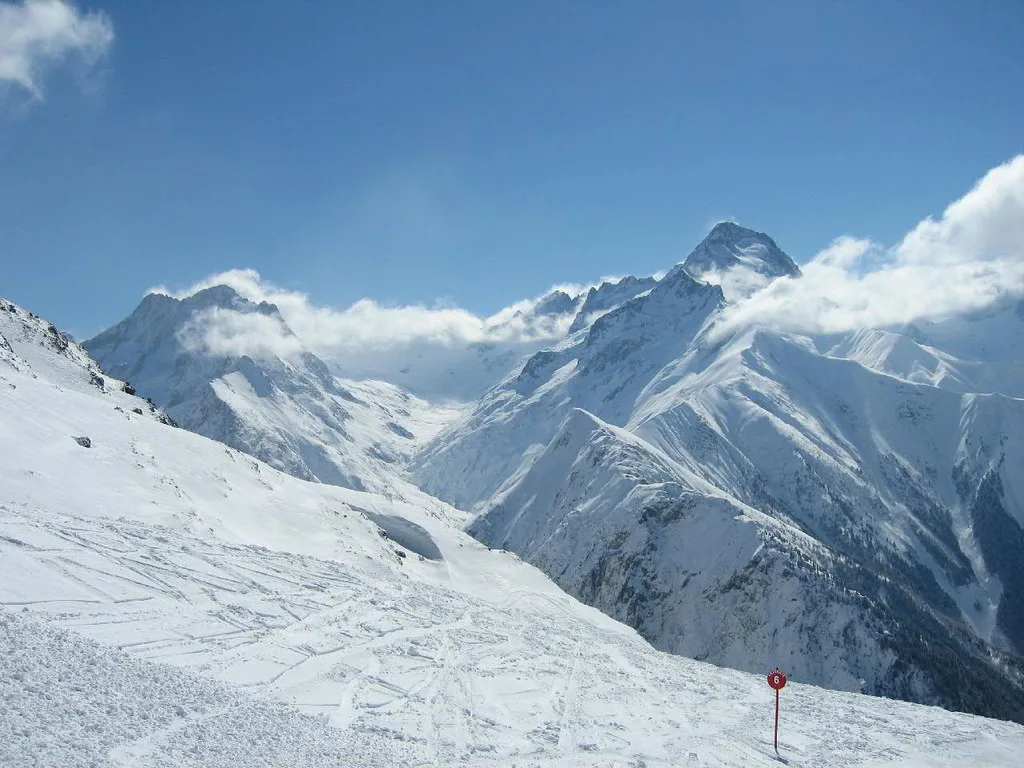
Toura, at 2,600 m, is listed in the official sector structure and described as home to the resort's freestyle zone, with the snowpark accessible to all levels and a dedicated avalanche-transceiver practice area. The piste-map overview describes Toura as the sector containing the snowpark and forming an important link between the lower mountain and the glacier lifts. For trip planning, the key point is that Toura is not only a freestyle destination — it is part of the route up.
For a group with riders who want to spend a day in the park, Toura gives you a clear base camp for the middle of the trip, with the rest of the network still reachable. The piste-map overview notes that the same sector offers wide open pistes alongside the park features, which means non-freestyle skiers in the group are not stranded if they ride up with the park crowd. Check the resort's live lift and piste information before committing a whole day to the snowpark, because park access is an operational matter rather than a fixed guarantee.
If you have a rider in your group and the rest are not interested in the park, plan the day around Toura as a through-route rather than a destination. That way the freestyle element happens in the middle of the day and the group continues higher afterwards, instead of splitting for the entire session. Consult the resort's live snow and lift status before you travel, because park features and the links above them depend on conditions.
Jandri and the Glacier to 3,600 m
The top of the network is listed as Jandri at 3,200 m, with glacier terrain reaching 3,600 m, and the official winter page gives the season window as 28 November 2026 to 2 May 2027. Those are the resort's stated operating dates, and they are conditional: they do not promise that every lift, piste or glacier link will run on a given day, so check the resort's live status rather than treating the window as a guarantee. For planning, the important decision is whether anyone in your group needs the top of the mountain at all.
The official sector pages describe the high-altitude zone with features including a glacier ice cave, orientation tables and a funicular with a new look, and describe the sector as open to pedestrians too. That pedestrian access matters for groups with non-skiers, because it gives them a route to share the high-altitude experience without needing to ski down. A piste-map overview separately describes the highest terrain as served by a gondola and glacier lifts with mostly open blue and red runs, but that summary is not the primary source for terrain difficulty — check the official piste map before relying on colour assumptions.
Reaching the top is a time commitment, because the vertical range means a long ascent and a long descent when you decide to come back down. Build that into your day plan rather than treating the glacier as a quick excursion, and pick a day when the rest of the group does not need to be somewhere else. Confirm the operating status of high-altitude lifts on the resort's own channels before you set out.
Lift Passes Explained: Day, Multi-Day, Family and Tribe Products
The operator's pass page sets out a product structure that includes a short-duration product for the bottom of the slopes, half-day and full-day options, holiday passes of several days, season passes and a multi-area product called Supernova. The same page also publishes family and tribe products with their own date windows, which means those are seasonal offers rather than permanent pricing tiers. Understanding the shape of the range is the first step; the second is checking which product applies to your travel dates.
The pass page publishes age categories that determine who pays a child, junior, adult, senior or grand-senior rate, and it states that children under five still require a pass even when free. Those categories are a practical planning detail that many groups discover late, so check the age bands against your group before you estimate anything. The same page is where any current-season pricing and booking conditions will appear, so treat it as the page to revisit close to your travel date.
The pass page also shows early-booking windows for season passes and date-banded family and tribe offers, which means the same product can have different conditions depending on when you book and when you travel. Never carry a window from one season into the next: confirm the current dates and terms on the operator's page rather than assuming they repeat. If you want the full breakdown of product names, boundaries and booking terms, use a dedicated les deux alpes ski pass guide alongside the operator's own page.
Pass Boundaries: Which Product Covers Which Lifts
The single most expensive mistake with Les Deux Alpes passes is buying a product whose boundary does not match your plans. The tourist office describes the short-duration product as covering only the bottom-of-the-slopes area, and the standard holiday pass as giving access to the resort's lifts, while the Supernova product is described as covering the Les 2 Alpes area plus Alpe d'Huez and La Grave. Those are different footprints, so the right question is where you intend to ski rather than how many days you are staying.
If your entire trip stays within Les Deux Alpes, a standard resort product is the simpler choice, and the short-duration bottom-of-slopes pass is the sensible option for a beginner who will not leave the lowest area. If you are considering a day in a neighbouring area, check what the multi-area product actually includes and which lifts it covers before paying a premium for it. Pass inclusions should never be inferred from a product name — the tourist office's page is the place to confirm them.
A common planning error is buying the widest product as a safety net and then never using the extra coverage, which wastes budget that could go towards lessons or hire. The reverse error is buying the cheapest product and discovering halfway through the week that it does not reach the terrain you want. Match the pass to a written plan of which sectors you will actually ski, then confirm the current inclusions on the tourist office's page before purchase.
Lessons and Progression: Schools, Instructors and Meeting Points
Lessons in Les Deux Alpes are provided by ski schools and independent instructors, and the official sector page states that the meeting points for ski schools and independent instructors sit at the snow front at resort level. That is an operational fact worth checking against your own booking, because a school may arrange a different meeting point for a specific course. Book lessons before you travel so you have written confirmation of where and when to meet, rather than working it out on the first morning.
The resort's own pages describe a range of mountain professionals, including state-qualified instructors and guides, working through schools and independently. That means the choice is not simply school versus no school, but which format suits your group: group lessons, private lessons or a guide for a specific objective. Check the format, group size and meeting arrangements directly with the provider before booking, because those details sit with the provider rather than with the resort's general pages.
For anyone planning a first week on skis, the sequence that usually works is to book lessons first and then choose a pass that matches the terrain the instructor will actually use. Booking the pass first can leave you paying for coverage you will not touch during a beginner week, or short of coverage if the instructor moves the group up the mountain. For the full decision path on lesson formats and progression, use a dedicated les deux alpes ski lessons guide alongside the provider's own terms.
Equipment Hire and On-Mountain Logistics
Equipment hire is available in resort through rental shops, and the resort's own material groups hire and lessons together under its guidance for preparing for a day on the slopes. The practical decision is where to collect and return gear relative to your accommodation and your first lift, because a short walk in ski boots at altitude is a different experience from a short walk at home. Confirm collection times and return arrangements with the shop when you book.
This guide does not recommend specific rental shops, because the right choice depends on your boot fit, your dates and where you are staying. What you can plan in advance is the type of equipment you need — for example, whether anyone in the group needs a beginner-friendly setup or a snowboard package — and then confirm availability directly with the shop. For a structured look at the options, use a dedicated ski hire les deux alpes guide alongside the shops' own booking terms.
On the mountain, the useful habit is to check the resort's live lift and piste information each morning rather than relying on the previous day's plan. Because this is one interconnected network, a closure in one sector can change the best route between two points, and the resort publishes opening information in real time. Build a fifteen-minute buffer into the start of each day for that check and for any gear adjustments.
Does Les Deux Alpes Fit Your Group?
The resort fits groups whose members want to ski different things from the same base, because one lift network covers beginner terrain, mid-mountain cruising and high-altitude runs without a road transfer in the middle of the day. It fits less well if your group's priority is a single style of skiing at one altitude, or if you want each day to be in a different resort. The honest question is whether the spread of sectors is useful to you or just unnecessary complexity.
It is the wrong choice if you are looking for guaranteed conditions on any specific date, because the resort's scheduled season is conditional and the live status is what matters on the day. It is also the wrong choice if what you want is a resort where every member of the group skis the same runs all week without negotiation. If your group is large, mixed-ability and happy to split and regroup, the structure is an advantage; if not, a smaller single-basin resort may be the better match.
One practical consideration for travel-day planning is that this is one of the larger Alpine resorts in terms of vertical range, which means the first and last hours of a trip can be absorbed by logistics. That is not a reason to avoid it, but it is a reason to plan the arrival day as a half-day and the departure day as a morning. If you want to compare the choice against another French resort with a similarly broad network, read the avoriaz skiing guide as a counterpoint before committing, or the Alpe d'Huez Skiing Guide if you are weighing the Supernova multi-area option.
Planning Sequence: From Resort Choice to Bookings
Start with the group, not the resort: write down who is skiing, what level they are at, how many days they will actually ski, and whether anyone needs a pedestrian or non-ski option. That list determines which sectors matter, which in turn determines which pass is appropriate. Doing this before you look at prices prevents the classic mistake of buying coverage nobody will use.
Second, book lessons and hire for the people who need them, because those bookings have limited capacity and the ski school confirms the meeting arrangements. Third, choose the pass based on the terrain your group will actually use, and confirm the current inclusions and age categories on the tourist office's page before paying. Fourth, check the resort's live lift and piste information in the final days before travel and adjust your sector plan if anything is limited.
Finally, accept that the season window is a schedule rather than a promise, and build flexibility into the week so a single closed link does not derail the trip. If you plan in that order, the resort's size works in your favour rather than against you. For the booking terms attached to lessons specifically, the les deux alpes ski lessons guide covers what to check with the ski schools before you commit.
Plan Your Les Deux Alpes Ski Trip
Les Deux Alpes earns its place on a shortlist through structure rather than any single statistic: seven named sectors in one connected network, from a 1,650 m snow front to glacier terrain at 3,600 m, with beginner provision, mid-mountain cruising and high-altitude runs reachable from the same base. If that spread matches your group, the resort is workable; if your group wants a single type of skiing at one altitude, it may be more than you need.
The decisions that shape your trip are the pass boundary, the lesson booking and the sector plan, and all three should be settled before you travel. Use the tourist office's own pages for anything that changes season to season, and use the sector structure in this guide to decide where your group will actually spend its time. Plan the first day as a half-day, check live lift status each morning, and treat the published season window as a schedule rather than a guarantee.
Explore more Les Deux Alpes guides
- Is Les Deux Alpes Expensive? What a Ski Trip Really Costs
- Is Les Deux Alpes Good for Beginners? Learning Areas and Planning Decisions
- Les Deux Alpes Ski Lessons
- Les Deux Alpes Ski Map
- Les Deux Alpes Ski Pass Guide
- Les Deux Alpes Ski Season
- Les Deux Alpes Snowboarding Guide
- Ski Hire in Les Deux Alpes
- Skiing in Les Deux Alpes in April
Frequently Asked Questions
How is the Les Deux Alpes ski area laid out?
The resort's official material describes seven sectors: the snow front at resort level, Belle Étoile and La Fée around 2,100 m, Le Diable at 2,400 m, Toura at 2,600 m, Jandri at 3,200 m and glacier terrain reaching 3,600 m, with the Vallée Blanche extension on the resort side. They form a single connected lift network rather than separate ski domains, so you can move between lower and higher terrain during the same day. Check current details on the official sector map for the definitive layout.
What lift passes are available in Les Deux Alpes?
The operator's pass page lists a short-duration product for the bottom-of-the-slopes area, half-day and full-day options, multi-day holiday passes, season passes and a multi-area product called Supernova that also covers Alpe d'Huez and La Grave. The same page publishes age categories and date-banded family and tribe offers. Because products, inclusions and booking terms change from season to season, confirm everything on the operator's own pass page before you buy.
Do you need the Supernova pass in Les Deux Alpes?
Only if you intend to ski outside the Les Deux Alpes area, since the Supernova product covers Les 2 Alpes, Alpe d'Huez and La Grave. If your whole trip stays within the resort's own network, a standard product is the simpler and usually more appropriate choice. Check current inclusions on the operator's pass page.
Where do ski school lessons meet in Les Deux Alpes?
The resort's official sector page states that meeting points for ski schools and independent instructors are located at the snow front at resort level. Individual schools may arrange different meeting points for specific courses, so treat the general location as a starting point and confirm the exact spot with your provider. Get the meeting time and place in writing when you book rather than working it out on the first morning.
How high does the skiing go in Les Deux Alpes?
The official sector structure lists Jandri at 3,200 m, with glacier terrain reaching 3,600 m, above mid-mountain sectors at 2,100 m, 2,400 m and 2,600 m. The glacier sits at the top of the same connected network rather than being a separate excursion, which means reaching it involves a long ascent and a long descent. Check the resort's live lift and piste information on the day, because high-altitude access is an operational matter.
When is the Les Deux Alpes ski season?
The resort's winter page gives a scheduled season window of 28 November 2026 to 2 May 2027. Treat that as a plan rather than a promise: the dates do not guarantee that every lift, link or piste will operate on any given day, and openings depend on conditions. Check the resort's live status in the days before you travel and again each morning during your trip.
Is Les Deux Alpes good for beginners?
The resort has beginner provision concentrated at the bottom of the mountain: the snow front at 1,650 m is described as having free ski lifts and as the location of ski-school meeting points, with a gentle zone at Belle Étoile just above it. A short-duration bottom-of-the-slopes pass exists for skiers who will not leave that area. Whether it suits your group depends on how long beginners will stay on lower terrain before wanting to explore further up.
Is Les Deux Alpes good for intermediate skiers?
The mid-mountain sectors give intermediates a natural progression path, with La Fée at 2,100 m offering a route towards the higher network and Le Diable at 2,400 m sitting above the resort. A piste-map overview describes those areas as containing a mix of blue, red and black runs, but terrain ratings should always be checked on the official piste map rather than inferred from a summary. The practical advantage for intermediates is that the sectors connect, so you can build a day that changes terrain without changing base.
Sources
- Ski and lift pass deals – Les deux Alpes ski pass | Ski resort Alps : Les 2 Alpes tourist office, ski vacations and mountain ski resort stay
- Mappa delle piste di sci di Les 2 Alpes – Zone e piste da sci | Stazione di sci Alpi : Ufficio del turismo Les 2 Alpes, vacanze di sci e soggiorno in montagna
- French Alps skiing – Deux alpes ski resort | Ski resort Alps : Les 2 Alpes tourist office
- Les Deux Alpes ski resort piste maps | Skiworld
Useful notes for your next ski trip
Optional updates to our Alpine resort guides.
You might also like
Continue reading
More guides you'll find useful