La Plagne Skiing: Paradiski Pistes, Sectors and Passes
Plan a La Plagne ski trip across 225 km of pistes, eleven villages, free beginner lifts, the Paradiski extension and the published season dates.
On this page
La Plagne skiing is less about a single resort and more about choosing a base within a 225 km ski area that spreads across high, purpose-built stations and lower, forested villages. The layout shapes everything that follows: how quickly you reach the glacier, whether the Vanoise Express is a day trip or a long detour, and how much walking you do in ski boots. Get the base right and the rest of the trip falls into place.
This guide works through the area's numbers, the sectors one by one, the pass products including the beginner-focused CoolSki option, and the practicalities of lessons, hire and getting around without a car. It sticks to what the resort publishes and points you to the right place when a figure has to be confirmed for your own dates.
What La Plagne skiing actually is: one ski area, eleven villages
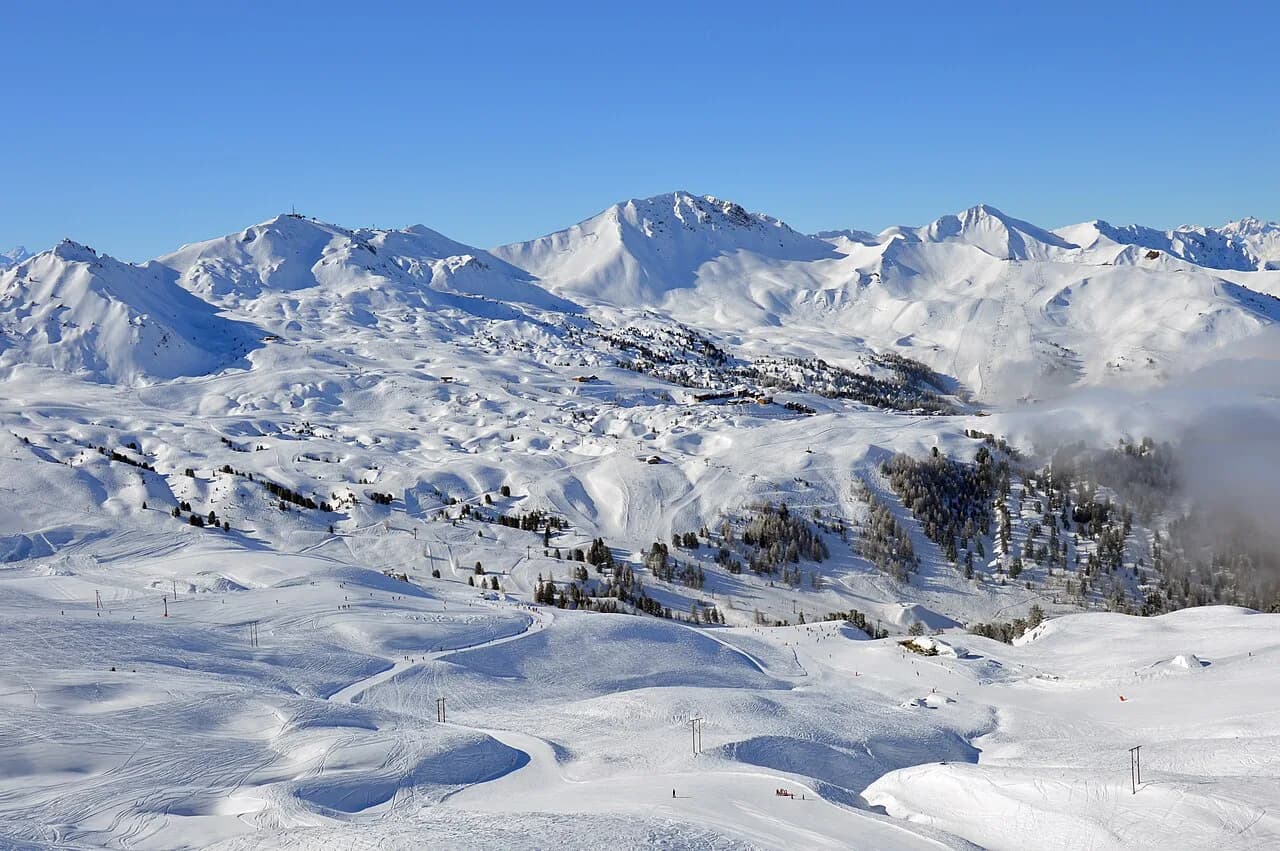
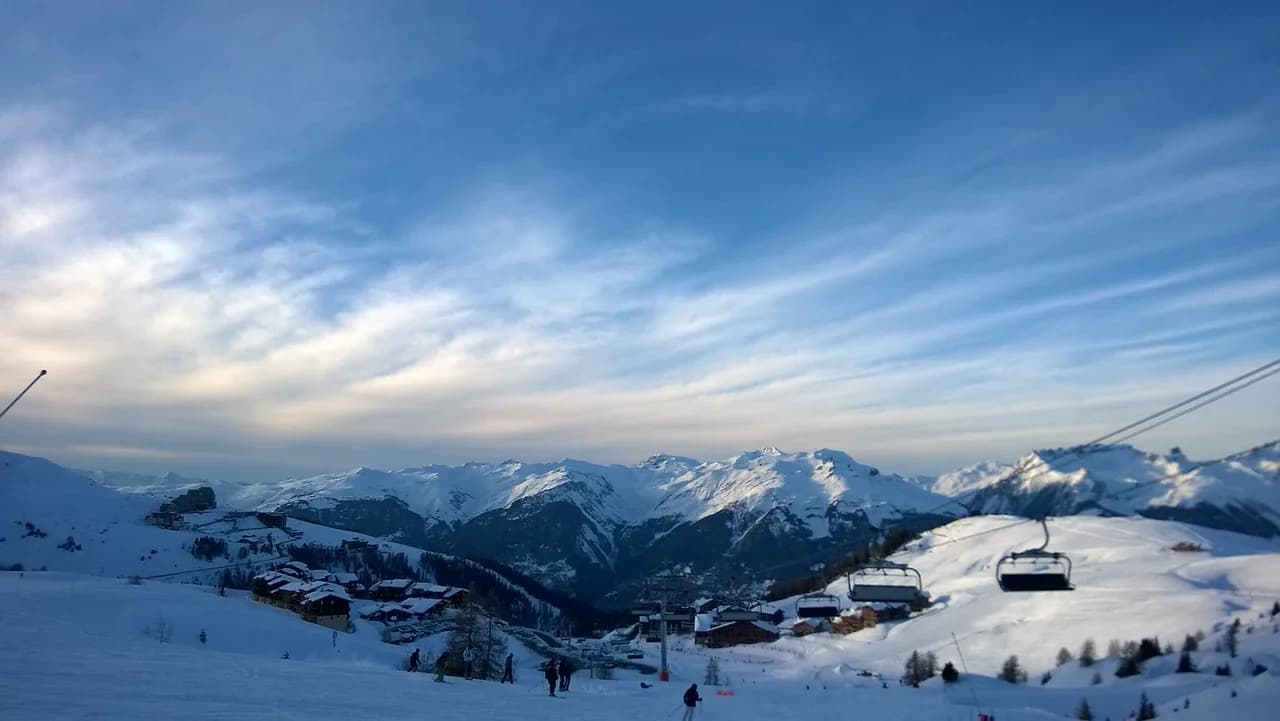
The resort describes itself as having eleven faces, and that is the most useful way to picture it. Six high-altitude stations sit between roughly 1800 m and 2100 m with ski-in, ski-out layouts, while Montalbert, Montchavin, Les Coches, Champagny-en-Vanoise and La Plagne Vallée sit lower and keep more of a village feel. All of them connect into the same lift network, so your accommodation choice is really a decision about which part of the mountain you start and finish each day on.
That structure gives you a genuine trade-off rather than a simple good-versus-bad choice. A high station such as Belle Plagne or Plagne Centre puts you on snow at the door and close to the glacier sector, but you are living in a purpose-built complex. A low village such as Montalbert gives you chalet architecture and trees, at the cost of a gondola ride before you reach the main network. Family skiers often prefer the lower villages for their calm, while groups chasing mileage gravitate upwards.
Before you commit to a base, open the La Plagne Piste Map alongside the accommodation listings. It shows how each village links into the lift system and where the return runs go, which is the detail that decides whether a chalet is truly ski-in, ski-out or a short shuttle ride from the snow.
The ski area in numbers: altitude, piste kilometres and lift count
The official figures are worth knowing because they frame every other decision. La Plagne publishes 225 km of downhill pistes served by 77 lifts and 139 runs, with the ski area topping out at 3080 m where the Glaciers 2 gondola arrives. Around 70 per cent of the terrain sits above 2000 m, which is the reason the upper slopes hold up through spring when lower runs are already softening.
The run split tells you who the area is built for. Of the 139 runs, 78 are blue, making gentle cruising the dominant character of the place, with 52 red and black runs for those who want pitch and length. Named high points such as La Roche de Mio at 2739 m, Grande Rochette at 2508 m and Les Verdons at 2500 m are the launching points for many of the blue and red descents, and the differing exposures mean you can follow the sun or chase colder snow depending on the time of day.
Treat the figures as a planning baseline rather than a promise for your week. Piste and lift openings change through the season, and the resort publishes live status information during the winter, so check it in the days before you travel.
Paradiski and the Vanoise Express: when the extension earns its keep
La Plagne is one half of Paradiski, linked to Les Arcs and Peisey-Vallandry by the Vanoise Express cable car. The combined domain publishes 425 km of runs, 129 lifts and a breakdown of 19 green, 128 blue, 77 red and 34 black pistes. That is roughly double the La Plagne total, and the crossing itself, with its transparent floor above the valley, is one of the more memorable lifts you will ride.
The practical question is whether the extension pays for itself on your trip. If you are skiing a week and want variety, one or two days on the Les Arcs side justifies the upgrade; if you have three or four days, or you are skiing with learners who will stay in the beginner zones, a La Plagne-only pass covers plenty. The resort sells Paradiski as either a full pass or an extension added to a valid La Plagne pass, so you can decide mid-holiday once you have seen how much ground you are covering.
Access matters here. Montchavin-les-Coches sits just a few turns from the Vanoise Express, which makes it the obvious base if crossing to Les Arcs is a priority. From Plagne Centre or Aime 2000 you are looking at a longer traverse across the La Plagne network before you even reach the cable car, which eats into the day. Compare the product lines in the La Plagne Ski Pass Guide, and check current fares on the official La Plagne site.
Sector by sector: Plagne Centre, Belle Plagne, Bellecôte and Plagne 1800
Plagne Centre is the hub, and the Grande Rochette funicular leaves from here for the 2508 m summit, giving direct access to blue and red runs without a chain of lifts. It is the most convenient base for mixed groups because shops, restaurants and the main lift corridors are all within a short walk. The trade-off is that it feels like a town rather than a mountain hamlet, and the architecture is unashamedly functional.
Belle Plagne and Plagne Bellecôte sit higher and closer to the glacier access. The La Roche de Mio and Glaciers gondolas leave from the Belle Plagne side, which puts the high-altitude terrain within a lift or two of your door, and the Arpette chairlift from Plagne Bellecôte serves the long Funslope that children tend to demand a second run on. Belle Plagne also has the liveliest bar scene of the high stations, so it suits groups who want a drink after the last lift.
Plagne 1800 is the smallest and quietest of the high stations, with its own ski school and a more relaxed pace, while Aime 2000 and the Plagne Villages and Plagne Soleil cluster add further bed capacity with quick lift access. If your priority is being on snow early and staying high all day, these sectors deliver. If you want atmosphere and a car-free centre, look lower.
Aime 2000, Plagne Villages, Plagne Soleil and the high-altitude feel
The satellite high stations share the same advantage: you wake up at altitude, which matters most in a low-snow week or a late-season trip. Plagne Villages and Plagne Soleil are arranged as small clusters with easy lift connections into the main network, making them a sensible choice for families who want ski-in, ski-out without the bustle of Plagne Centre.
Aime 2000 is the highest of the purpose-built stations and gives fast access to the upper slopes, but it is also the most exposed when weather closes in. On a storm day you may find yourself riding lifts lower down the mountain instead, so weigh how much you value altitude against how much you value shelter and trees. Neither choice is wrong; they simply suit different weeks.
The low villages: Montalbert, Montchavin-les-Coches and Champagny-en-Vanoise
Plagne Montalbert sits at 1350 m with wood-and-stone buildings, a car-free centre and parking at the village entrance, and a gondola lifts you to the Fornelet summit where a blue run winds back through the forest. It is a strong base for families who want a real village and easy beginner terrain, and its own village pass covers the local slopes for anyone not ready for the whole domain.
Montchavin-les-Coches spreads across two levels, with Montchavin at 1250 m keeping a working farm, chapel and pedestrian centre, and Les Coches at 1450 m offering more contemporary accommodation and the quickest route to the Vanoise Express. This is the sector to pick if Paradiski crossings and tree-lined skiing in poor visibility matter more to you than altitude.
Champagny-en-Vanoise anchors the far end of the area at the edge of the Vanoise National Park and holds the main Nordic centre, with 23 km of cross-country trails on its side. The low villages generally close their lifts slightly earlier in spring than the high terrain, so a late-April booking belongs up top.
Best areas for beginners and first-timers, including free beginner lifts
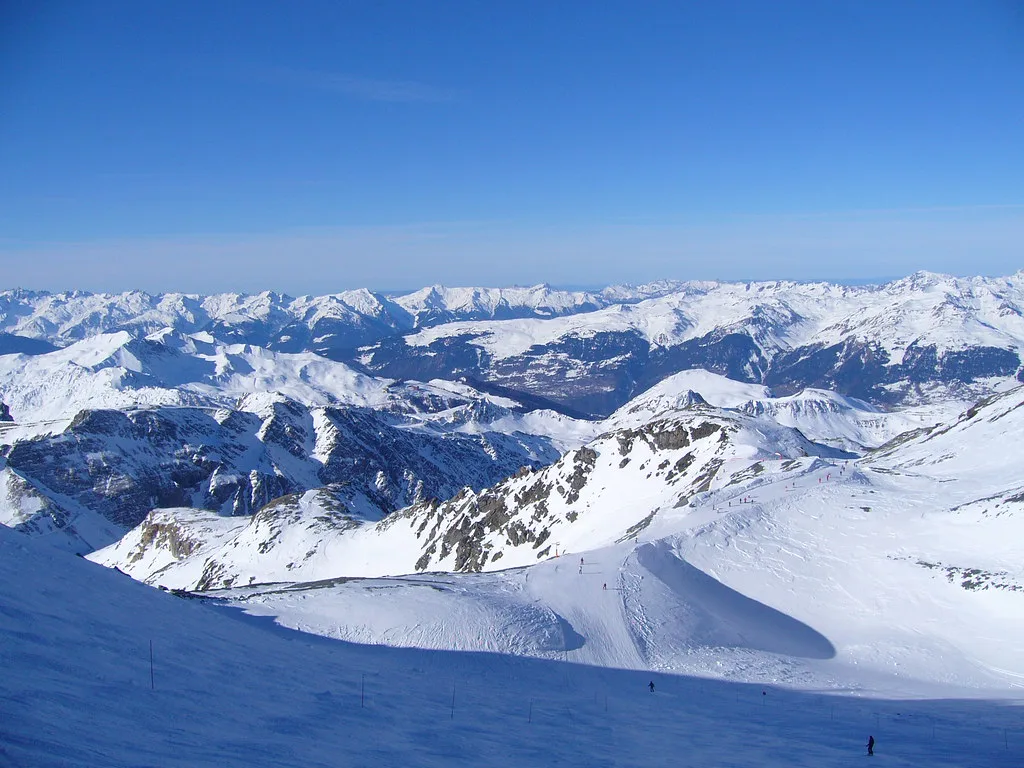
La Plagne is unusually well set up for learners. The Funslope at Plagne Bellecôte and the beginner spaces at Montalbert, Montchavin and Les Coches are free to use, which means a first-timer can try the sport before committing to a pass. Dedicated zones such as the Grenouille area at Montalbert give children somewhere to build confidence without traffic from fast skiers.
CoolSki is the product built around this. It uses pink signage to mark protected zones with gentle slopes and learning modules, and the resort listed it at a single day rate of 39 euros for the 2025-26 season. Treat that as a benchmark for what a beginner day costs, note the season it belongs to, and confirm the rate in force for your dates before you budget.
Where you stay changes the beginner experience more than any pass. Montalbert and Montchavin both put learning terrain and ski school meeting points close to the accommodation, whereas a base at Aime 2000 means a lift ride before lessons begin. Piste map reading helps here too: check that the runs back to your village are green or blue before you book.
Intermediates and advanced skiers: blues, reds, blacks and the glacier
Intermediates are the happiest skiers in La Plagne. The 78 blue runs let you cross the area end to end without ever being forced onto something steep, and the linked Paradiski domain adds another 128 blues for days when you want new ground. The high points at La Roche de Mio and Grande Rochette give long, confidence-building descents with big views over the Vanoise glaciers.
Strong skiers have 52 red and black runs locally and 111 in the wider Paradiski area, plus the 3080 m glacier sector reached by the Glaciers 2 gondola for the Live 3000 experience. The resort also marks seven ski touring trails, free to access without a pass, with descents back down the piste network, which suits fit skiers wanting a morning of uphill work before a normal afternoon.
Snow parks, fun slopes and non-piste skiing
Riders Nation is the main snowpark, supported by boardercross courses at Champagny-en-Vanoise and Montchavin-les-Coches. Add the Funslope, Buffalo Park and Buffalo Kids play runs and the Equalizer light tunnel, and there is enough structured freestyle and family fun to fill the days when the group splits between cruisers and park rats.
Off the downhill pistes, the resort lays out 55 km of cross-country trails across Champagny-le-Haut, Montchavin-les-Coches and the Versant du Soleil, most of it free to use and reachable without lifts, apart from the Champagny Nordic area. Non-skiers are well covered too, with pedestrian-accessible lifts to high-altitude restaurants, a bobsleigh track, ice skating and marked winter walking routes.
Season dates and snow reliability from December to April
For the 2026-27 winter, the resort publishes 12 December to 24 April for Plagne Centre and the high resorts, and 12 December to 17 April for Champagny, Montchavin-les-Coches and Montalbert. These are next-season dates rather than current conditions, and the pattern is consistent with the resort's usual approach: high terrain opens first in December and closes last in April, with the lower villages finishing a week or so earlier.
Spring is a genuine option rather than a compromise. With more than 70 per cent of the terrain above 2000 m, March and April skiing holds up well, and softer snow and longer days reward anyone willing to shift their trip later. The first slopes to close are the low ones at Montchavin-les-Coches and Montalbert, so late bookings belong up high.
Lift pass products: La Plagne, village passes, CoolSki and Paradiski
The pass structure follows the geography. A La Plagne pass covers the 225 km local area, village passes at Montalbert and Montchavin-les-Coches cover the slopes around those villages for beginners and short stays, CoolSki opens the protected beginner zones, and the Paradiski pass or extension adds Les Arcs and Peisey-Vallandry. Pre-holiday weeks often carry a reduced rate, which makes early December a value option for confident skiers.
Buying in advance online is the simplest route, and it lets you pick up passes without queueing on arrival morning. Where prices for the main passes are concerned, the official site is the place to confirm what applies to your dates, and the La Plagne ski pass breakdown is worth reading before you decide between local cover and the full domain.
Ski schools, lessons and equipment hire
Ski schools operate from each village, including ESF branches at Belle Plagne, Plagne 1800, Plagne Montalbert, Montchavin and Les Coches, plus an international school at Montchavin. Group lessons keep costs down and give children a social day, while private lessons suit adults fixing a specific habit or nervous returners. Book early for the Christmas, February and Easter weeks, when the popular time slots fill first.
Hire shops sit in every village, and the resort advises booking equipment alongside accommodation and passes so you are not shopping around on arrival. For a first week, choosing a shop close to your lift station saves carrying skis across a resort, and asking staff about touring or freeride kit is worthwhile if you plan to use the marked ski touring trails.
If you want to compare lesson formats and booking questions before you commit, the La Plagne ski lessons guide sets out what the schools offer for adults and children.
Getting there and getting around without a car
La Plagne sits in the Tarentaise valley in Savoie, with Chambery the nearest airport and larger gateways at Lyon and Geneva a longer transfer away. Aime-la-Plagne, down in the valley, has a train station served year-round, with direct TGV services from Paris and Lyon added during the winter season, which makes rail a realistic option for skiers avoiding airport transfers.
Once you are in resort, free shuttle buses link the villages and stations, and some lift connections run in the evening to move people between accommodation and restaurants. That network means a car is optional rather than essential. If you do drive, the resort recommends booking parking online in advance when your accommodation does not include a private space, particularly in the high stations where space is tight.
Where to stay for the skiing you want
Match the base to the skiing, not the photographs. Choose Belle Plagne or Plagne Bellecôte for glacier access and quick high-altitude mornings, Plagne Centre for convenience and the funicular, Montchavin-les-Coches for the Vanoise Express and tree-lined skiing, and Montalbert for a family village with its own gentle slopes. Aime 2000 and the Plagne Villages and Soleil cluster suit anyone who wants altitude without the busiest centre.
Book early for school holidays, when the resort advises securing accommodation well ahead to keep the widest choice of apartments and hotels. January and March are quieter and often better value, which makes them a sensible window for flexible groups. Whatever you choose, plan the trip around the area you will actually ski rather than the prestige of the address.
Who La Plagne suits, and who it does not
La Plagne is at its best for families, improving intermediates and groups who want a lot of blue terrain, reliable snow high up and a choice between buzz and calm in the evening. The free beginner lifts and the CoolSki zones make it an unusually low-risk place to learn, and the 3080 m summit means spring weeks still have something to ski.
It is a weaker fit for skiers who want a single handsome village at the foot of the lifts, or who plan to spend most of the week on steep, technical terrain. If your ideal trip is a compact, atmospheric base with hard skiing on the doorstep, the Alpe d'Huez Skiing Guide may suit better; if you want a purpose-built, car-free resort with a strong beginner offering, compare with the Flaine Skiing Guide.
Wherever you land in the eleven villages, confirm lift opening and current pass prices on the official site close to departure, then book accommodation, passes and equipment in that order. The decisions that matter most are your base and your pass coverage, and both are easy to get right once you know how the area is put together.
Explore more La Plagne guides
- La Plagne Piste Map
- La Plagne Ski Hire
- La Plagne Ski Lessons
- La Plagne Ski Pass Guide
- La Plagne Ski Season Dates
- La Plagne Skiing in March
- La Plagne Snowboard Lessons
- La Plagne Snowboarding
- Skiing in La Plagne in April
- Alpe d'Huez Skiing Guide
- Méribel Ski Guide
- Morzine Ski Guide
- Courchevel Skiing
- Avoriaz Skiing
- Val d'Isère Skiing
- Les Gets Skiing
- Megève Skiing
- Tignes Skiing Guide
- Flaine Skiing Guide
- Les Deux Alpes Skiing
- Val Thorens Skiing Guide
- La Clusaz Skiing
- Montgenèvre Skiing
- Serre Chevalier Skiing
- Samoëns Skiing
- Valmorel Skiing
- Val Cenis Skiing
- Les Houches Skiing
- Les Menuires Skiing Guide
- Chamrousse Skiing
- Valmeinier Skiing
- Le Grand Bornand Skiing
- Valloire Skiing
Frequently Asked Questions
Is La Plagne good for skiing?
Yes, if you like wide cruising terrain and reliable altitude. La Plagne publishes 225 km of pistes and 139 runs, with 78 of them blue, and around 70 per cent of the terrain sits above 2000 m, so the upper slopes hold snow late into spring. It is less compelling if your week is built around steep, technical descents, though the Paradiski link adds 111 red and black runs on the Les Arcs side.
How many kilometres of piste does La Plagne have?
La Plagne has 225 km of downhill pistes served by 77 lifts, according to the resort. The linked Paradiski domain, which joins La Plagne with Les Arcs and Peisey-Vallandry via the Vanoise Express, publishes 425 km and 129 lifts. Check the piste map before travelling to see which runs and lifts are scheduled to be open in your week.
Do you need a Paradiski pass to ski in La Plagne?
No. A La Plagne pass covers the local 225 km network, and village passes at Montalbert and Montchavin-les-Coches cover the slopes around those villages. Add the Paradiski extension, or buy a full Paradiski pass, only if you want to cross to Les Arcs and Peisey-Vallandry by the Vanoise Express. The resort sells the extension as an add-on to a valid La Plagne pass.
Is La Plagne good for beginners?
It is one of the better French areas for learning. The resort lists 16 lifts in the beginner areas that cost nothing to ride, and dedicated zones at Montalbert, Montchavin and Les Coches, plus a free Funslope at Plagne Bellecôte, keep learners away from fast traffic. The CoolSki product marks protected zones with pink signage, and ski schools run from every village.
When does the La Plagne ski season start and finish?
For the 2026-27 winter the resort publishes 12 December to 24 April for Plagne Centre and the high stations, and 12 December to 17 April for Champagny, Montchavin-les-Coches and Montalbert. High terrain opens first and closes last, with lower slopes finishing earlier in spring. Confirm the dates in force for your own trip on the official site.
Which La Plagne village is best for skiing access?
It depends on the skiing you want. Belle Plagne and Plagne Bellecôte give the quickest access to the glacier sector, Plagne Centre puts the Grande Rochette funicular on your doorstep, and Montchavin-les-Coches is the closest base to the Vanoise Express. Montalbert suits families who want a car-free village with gentle local slopes and a gondola up to the main network.
Sources
- La Plagne ski holidays in the French Alps - Paradiski french resort
- Ski resort opening : Open ski slopes | La Plagne
- La Plagne piste map : Piste and lifts map Champagny, Montalbert, Montchavin
- Welcome to La Plagne
- Plagne Montalbert Family Ski Resort - Vacation
- First time on ski ? Schools and easy slopes to start skiing in La Plagne
Useful notes for your next ski trip
Optional updates to our Alpine resort guides.
You might also like
Continue reading
More guides you'll find useful