Arosa Snowboarding Guide: Parks, Pistes and Lift Access
Plan a snowboard trip to Arosa with our guide to the snowparks, beginner zones, linked Lenzerheide terrain, lift access and what to book before you go.
On this page
Arosa rewards snowboarders who treat it as one area rather than two villages. The Arosa and Lenzerheide halves are joined by the Urdenbahn cable car across the Urdental valley, and a single lift pass covers both, so a day can start on the Arosa side and end on a Lenzerheide descent without rebooking anything.
What follows is a planning guide, not a park edit: where the freestyle areas sit and who each one suits, which sectors match your riding level, how the published winter periods shape a trip, and how tickets and transport fit together. Live status, individual park set-ups and prices change, so the last word comes from Arosa Lenzerheide Bergbahnen's own pages rather than from this article.
What Arosa Offers Snowboarders
The Arosa Lenzerheide ski area is a single interconnected domain with pistes for all ages and abilities, terrain reaching up to 2,865 metres above sea level, and more than 40 mountain huts, which makes it straightforward to build a full day around riding rather than logistics. The official live status page counts the domain in 43 lifts and 225 kilometres of slopes, a useful scale check when you are deciding how many days to book.
That size matters for boarders because the two halves have different characters: Arosa's core runs above the village on the Weisshorn and Hörnli shoulders, while Lenzerheide stretches over a longer ridge with its own summit lifts. Riding both on one ticket is the main reason to give Arosa more than a weekend. For the wider resort picture, the Arosa ski guide covers terrain, tickets and winter planning in one place.
How the Area Is Laid Out
Arosa sits at one end of the domain and Lenzerheide at the other, with the Urdenbahn gondola crossing the Urdental valley between Hörnli on the Arosa side and Urdenfürggli on the Lenzerheide side. The crossing takes about five minutes, which turns what would be a road transfer into a single lift ride and makes a two-base trip genuinely practical.
On the ground, each half is served by its own web of chairs, gondolas and surface lifts, and the Urdenbahn is the only link, so a day plan should account for where you enter and exit the system. Arosa's lifts cluster around the Weisshorn cable car, the Hörnli-Express and the Kulm–Tschuggen axis, while Lenzerheide's spread from Rothorn across to Stätzerhorn and Scalottas. The Arosa piste map guide explains how the published labels and legend translate into that layout.
The Snowpark Line-Up
Arosa Lenzerheide publishes five snowpark areas rather than one flagship park, and they are deliberately graded. Snowpark Tschuggen sits to the right of slope 15 with two separate lines mixing waves, moguls, obstacles and kickers, which makes it the natural home for riders who already have park basics. On the Heidbüel side, the Stätz JibArea runs 1.4 kilometres with up to 45 takeoffs and as many as 20 obstacles in a single line, built with boxes, rails and kickers in a range of sizes.
At the easier end, the Fadail Garden is pitched at first park experiences, from simple boxes to a first tube, with snow shapes and small jumps to build confidence. The Bärensnowpark at the Ried ski lift is a different proposition again: four adventure slopes for children aged roughly six to twelve, themed around a bear's-eye view of stream, forest path, rock slope and wind river, with simple obstacles rather than kickers.
The fifth is Wood Ranch, a nature park built entirely from Arosa fir on the descent towards the Weisshornbahn valley station near slope 15, funded by crowdfunding and described by Arosa Lenzerheide Bergbahnen as CO₂-neutral. Treat the line-up as a menu rather than a checklist: park set-ups are rebuilt through the season, so the Bergbahnen's live overview of which areas are open is the only reliable guide on the day.
Freestyle Terrain in Detail
Think of the parks in three tiers. Tschuggen and the Stätz JibArea are the progression parks, best suited to riders comfortable with speed control, switch riding and committing to a line; Stätz rewards a lap-based session because everything is stacked along one long line rather than scattered. Fadail Garden and the Bärensnowpark are the entry and family tier, where the point is a first box or a first tube rather than amplitude.
Wood Ranch occupies its own niche as a built feature line with a visual identity, so session it on its own rather than as a warm-up for something bigger. Whichever park you target, ride it early in the day when the snow is still firm and the line is short, and check the park's status before travelling across the valley to reach it.
Riders coming from other Swiss domains often compare park culture across resorts, and the Davos snowboarding guide is a useful contrast if you are weighing two trips in the same season. Within Arosa itself, the Arosa piste map puts the parks in context with the pistes that feed them.
Beginner and First-Timer Zones
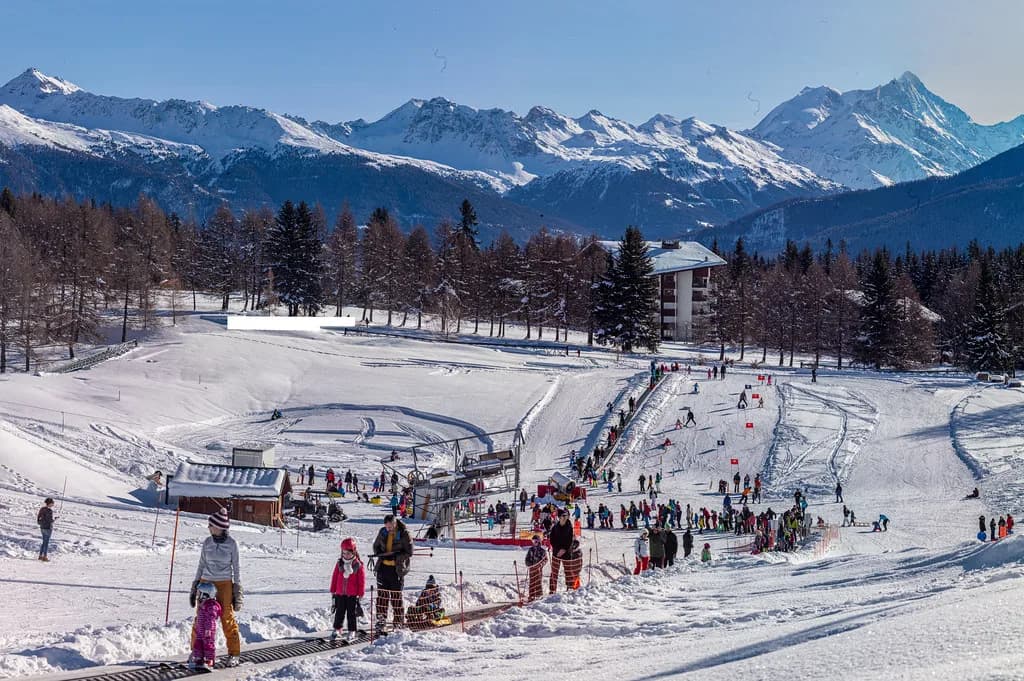
Two beginner facilities stand out because they cost nothing to use, which is unusual in a domain of this size. Honigland Prätschli, next to the Prätschli ski lift in Arosa, is a free beginners' and children's area with a 45-metre conveyor belt, the sort of gentle, low-commitment set-up that suits a first hour on a board. The Bärensnowpark at the Ried ski lift is likewise free and open to the public, so families can rotate between the two without buying extra access.
Beyond the free zones, the domain's gentler terrain does most of the work for new boarders: the Arosa side has long, wide runs off the Kulm and Tschuggen lifts, and Lenzerheide's eastern sectors around Rothorn offer forgiving pitches. Book lessons and rental through the resort's own ski school and hire partners rather than improvising, and ask specifically for snowboard instruction, since a ski-first school may run board groups on separate timetables.
Which Sectors Suit Which Rider
Arosa's Kulm and Tschuggen lifts serve some of the most accessible riding in the domain, with a cluster of blue and red pistes feeding back to the same base, which keeps laps efficient for improvers. Further up, Weisshorn and Hörnli deliver the altitude and the steeper, higher-energy terrain, and Hörnli is where the Urdenbahn crossing begins.
Lenzerheide's sectors each have a distinct job: Rothorn for long top-to-bottom runs and the widest spread of pitch, Stätzerhorn for the steeper, more technical side, and Scalottas for a quieter western feel. The operating overview notes that some western Lenzerheide lifts around Scalottas and Stätz tend to open earlier, especially at weekends, during the later peak phase, which is worth knowing if you plan a late-season trip around those sectors.
You do not have to choose a side for the whole holiday: base in one village, ride it in the morning and cross the Urdenbahn for the afternoon. The main trade-off is time in transit versus terrain variety, and on a short trip the crossing is usually worth it once rather than daily.
Season Timing and What Is Realistically Open
Arosa Lenzerheide Bergbahnen publishes winter in four phases: a pre-season from 28 November to 18 December 2026 with daily partial operation while the ski area is built up, peak operation from 19 December 2026 to 11 March 2027, a second peak phase from 12 March to 4 April 2027, and an off-season from 5 to 11 April 2027 when most Arosa lifts and the eastern Lenzerheide side around Rothorn stay open. Opening dates are listed as the earliest possible and are adjusted up to about three days ahead, so early-season plans should stay flexible.
For snowboarders the practical read is simple: a pre-Christmas trip is a gamble on snow and terrain, the mid-December to early-April window is when the full network and most pistes run, and the final week is a partial system with last-minute changes. If your dates sit near a phase boundary, the Arosa Ski season dates page sets out how those published phases work in practice.
Do not build a trip around one specific park during the shoulder phases; park areas are prepared and taken down with the season, and the overview that lists open areas updates continuously. Build your day around the lifts that are confirmed running instead.
Lift Passes: Products, Loading and Pickup
The one-day ski ticket covers the entire Arosa Lenzerheide ski area and is also valid for winter hiking and tobogganing where transport is allowed. Multi-day tickets run on consecutive days from the start date you select, and they cannot be refunded, transferred or moved to another day outside the published refund rules, so choose dates carefully before paying.
Loading is where most people trip up. You can add a Skidata keycard or your physical SwissPass during the booking, in which case the authorisation sits on the card and works directly at the turnstile; if you add neither, you collect the ticket at a lift company sales point or a ticket machine in the resort by showing the QR code from your booking confirmation. A card is the smoother option if you already hold one.
Prices depend on season phase and ticket length, and the current figures sit on the official shop rather than anywhere else, so check the product page against your dates before you commit. Season passes and the TOP CARD sit alongside day tickets in the same shop; the Arosa Ski pass overview explains how the products differ.
Getting There and Getting Around
Travel to Arosa works on the narrow-gauge Rhätische Bahn from Chur, and the region is also served by PostBus on the Chur–Lenzerheide–Tiefencastel route. The useful detail for boarders is that when you hold an Arosa Lenzerheide lift ticket and use the resort lifts for winter sports, second-class travel on those routes is included, provided you show the booking confirmation with official photo identification at inspection.
That inclusion shapes base decisions. Staying in Chur and riding the train up becomes viable for a day or two, and moving between Arosa and Lenzerheide by public transport costs nothing extra on a riding day, though the Urdenbahn remains the fastest way across the mountain. Carry the photo ID you used, since the transport benefit is checked at inspection rather than at the lift.
If you are comparing Swiss domains before booking, the Zermatt snowboarding guide shows how a very different, high-altitude layout handles park and lift access, which is a useful benchmark against Arosa's two-hub arrangement. Within Arosa, the Arosa Skiing pillar covers the winter planning basics in more depth.
Where to Base Yourself
Arosa is compact, with the village sitting under the Weisshorn and Hörnli lifts and the free Honigland Prätschli area close at hand, which suits families and anyone wanting short walks to the first lift. Lenzerheide spreads along the valley with a longer approach to its main lift bases, but it puts Rothorn, Stätzerhorn and Scalottas on your doorstep if steeper and more varied riding is the priority.
The Urdenbahn changes the calculus. Because the crossing takes only a few minutes, a two-base trip is genuinely workable: a few nights in Arosa for the parks and beginner zones, then a move to Lenzerheide for the western sectors, all on one pass. The trade-off is packing and check-in time mid-holiday versus the variety you gain.
For a first visit with mixed abilities, Arosa is the easier base, because the free beginner areas, the Tschuggen and Fadail park zones and the Kulm laps are all within a short distance of each other. Experienced riders with a full week should sleep on the Lenzerheide side for at least part of the trip.
What to Book Early and the Trade-offs Worth Knowing
Book lift passes online before you travel, ideally loading a keycard or SwissPass so you can go straight to the turnstile, and book rental and lessons as soon as your dates are fixed, because school-holiday weeks fill first. Multi-day tickets are non-transferable, so lock in dates only once your travel is confirmed.
The other trade-offs are terrain against convenience. A base near the lifts shortens mornings but costs more, a valley base saves money but adds a commute, and early-season or late-season dates buy quieter slopes at the price of partial operation. Decide which of those you can live with before you compare accommodation, then check the published operating phases against your chosen week.
Plan Your Snowboarding Trip to Arosa
Arosa works well for snowboarders because the domain is generous without being confusing: one pass covers Arosa and Lenzerheide, the Urdenbahn links them in minutes, and five graded park areas mean there is a suitable line whether you are trying a first box or sessioning the Stätz jib line. Get the ticket mechanics and season phase right, and the rest of the trip organises itself around the lifts.
Check the park status, lift operating times and current ticket details on the Arosa Lenzerheide Bergbahnen pages shortly before you travel, since park set-ups and early or late-season schedules are adjusted close to the date. Then commit to a base, book the pass and the lessons, and plan at least one crossing of the Urdental to ride both sides.
Frequently Asked Questions
Where are the snowparks in Arosa and which suits a beginner snowboarder?
Arosa Lenzerheide lists five snowpark areas. Snowpark Tschuggen sits to the right of slope 15 with two lines, and the Stätz JibArea on the Heidbüel side runs 1.4 kilometres with up to 20 obstacles in one line, so both suit riders with park basics. Beginners should start at the Fadail Garden, built for first boxes and a first tube, or at the free Bärensnowpark at the Ried ski lift, which is aimed at children and uses simple obstacles.
Can you snowboard from Arosa to Lenzerheide on one lift pass?
Yes. Arosa and Lenzerheide form one interconnected ski area, and the one-day and multi-day ski tickets cover the whole domain. The two halves are joined by the Urdenbahn gondola across the Urdental valley, which links Hörnli on the Arosa side with Urdenfürggli on the Lenzerheide side in about five minutes.
Are there free beginner areas in Arosa for snowboards?
Two beginner facilities are free to use. Honigland Prätschli, next to the Prätschli ski lift in Arosa, is a beginners' and children's area with a 45-metre conveyor belt and no access charge. The Bärensnowpark at the Ried ski lift is also free and open to the public, with four themed adventure slopes for children roughly six to twelve years old.
When does the Arosa Lenzerheide snowboard season start and finish?
Arosa Lenzerheide has a winter pre-season from 28 November to 18 December 2026 with daily partial operation, full peak operation from 19 December 2026 to 11 March 2027, a second peak phase to 4 April 2027, and an off-season from 5 to 11 April 2027 with a reduced lift network. Early-season dates are listed as the earliest possible and are adjusted close to the time, so check the operating hours page for your week.
How do you buy and load an Arosa Lenzerheide lift pass?
Buy the ticket through the official Arosa Lenzerheide shop, choosing your start date and number of days. During booking you can add a Skidata keycard or your physical SwissPass, in which case the authorisation is loaded on the card and works at the turnstile. If you add no card, collect the ticket at a lift company sales point or ticket machine by showing the QR code in your confirmation.
Is Arosa better than Lenzerheide as a snowboarding base?
Arosa is the easier base for a first trip or a family group: the village is compact, the free Honigland beginner area sits by the Prätschli lift, and the Tschuggen and Fadail park zones plus the Kulm laps are close together. Lenzerheide puts the Rothorn, Stätzerhorn and Scalottas sectors on your doorstep, which suits stronger riders. Because the Urdenbahn connects the two in minutes, splitting your stay between them is realistic.
What does a lift pass in Arosa include beyond skiing?
The ski ticket is also valid for winter hiking and for tobogganing where transport is permitted. It additionally covers second-class travel on the RhB route between Arosa and Chur and the PostBus route between Chur, Lenzerheide and Tiefencastel when you are using the resort lifts for winter sports, provided you show the booking confirmation and official photo identification at inspection.
Sources
Useful notes for your next ski trip
Optional updates to our Alpine resort guides.
You might also like
Continue reading
More guides you'll find useful