Corvara Ski Pass: Which Alta Badia Ticket to Buy
Sort your Corvara ski pass: what the Alta Badia ticket covers, when the Dolomiti Superski upgrade pays off, and how online buying and card collection work.
On this page
Corvara is one of five Alta Badia villages strung along the valley floor, and almost every lift ticket you buy here starts with the same question: do you stay inside Alta Badia for the week, or pay for the wider Dolomiti Superski network? The answer depends on how far you plan to roam, because the local area alone is big enough for most weeks. Sort that decision first and the rest — duration, purchase channel, card type — falls into place.
The mechanics are simple once you know them. Alta Badia publishes its own piste figures and lift count, sells passes both at village offices and online, and hands out a reusable My Dolomiti Card that you reload rather than replace. What follows is a practical walk-through of coverage, dates, buying channels and the Italian rules that apply to everyone on the snow this season.
What the Corvara ski pass actually covers
A Corvara lift pass is an Alta Badia pass, and Alta Badia is the network of slopes and lifts reached from Corvara, Colfosco, San Cassiano, La Villa and Badia, plus the terrain around the Campolongo, Falzarego and Gardena passes. Alta Badia's own figures put the area at 130 piste kilometres served by 54 interconnected lifts, all reached on one ticket. In practice that means you can start on the Boé gondola above Corvara and finish the day above La Villa without buying anything extra.
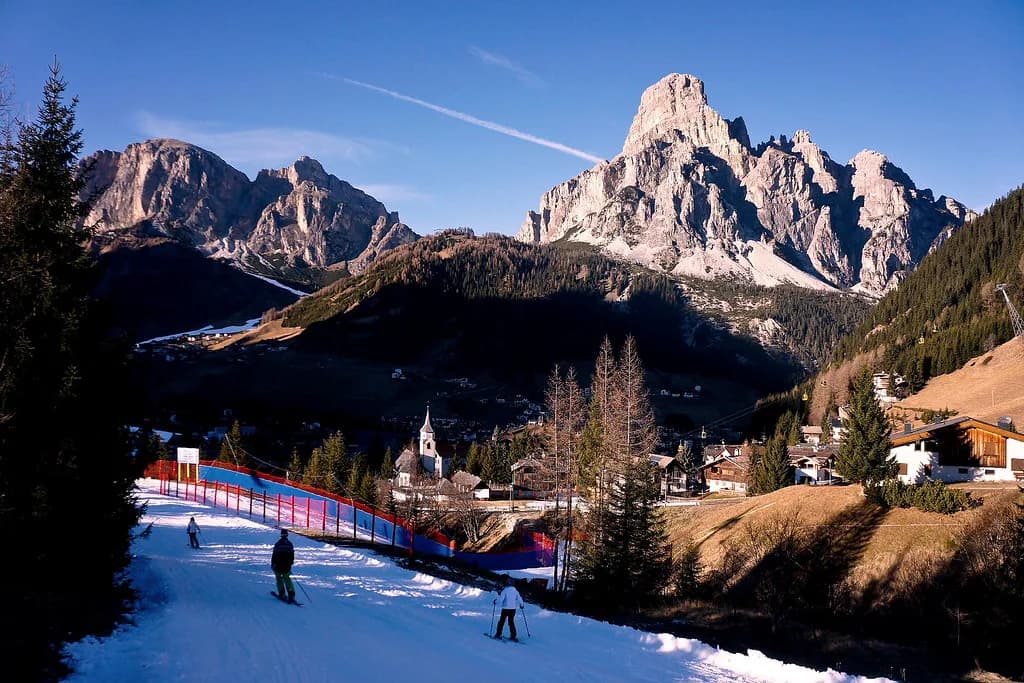
Corvara itself is the natural base for the eastern half of the area: the Col Alto and Boé lifts rise straight from the village, and the Sassongher and Piz Boè peaks frame the runs above it. Colfosco, a short ski or bus ride up the valley, opens the connection towards the Sella Ronda and the Gardena Pass. For a sense of how the sectors knit together before you commit to a ticket, the [corvara ski map](/corvara-piste-map-guide) is worth ten minutes of your evening.
Snowmaking backs up the groomed surface across the network, which matters in a valley that sits between 1,300 and 2,800 metres. Low runs back into the villages can soften in a warm spell, while the upper pods around Piz Boè hold condition far longer. Plan your day upwards if the forecast turns mild, and keep the village-level runs for the colder mornings.
Alta Badia vs Dolomiti Superski: deciding which pass you need
The decision rule is straightforward. If your week is about learning, cruising the Alta Badia runs and eating well on the mountain, the local pass does the job and keeps the cost down. If you want the Sellaronda circuit, a day towards Val Gardena or Arabba, or the First World War tour, you need Dolomiti Superski coverage, which opens 1,200 piste kilometres and 450 lifts across twelve resorts on a single ticket.
A useful compromise is to buy the local pass for most of the week and pick up Superski days for the one or two big circuits. Dolomiti Superski sells flexible products along these lines, including eight non-consecutive Dolomiti Superdays and a local season pass topped up with four Superski days. Work out how many days you will genuinely leave the valley before choosing, because upgrading later usually costs more than buying the right product first.
Remember that the Sellaronda runs on Alta Badia's doorstep rather than inside it. The circuit is graded moderate and covers roughly 40 km in either direction, taking around four to four and a half hours at a sensible pace. That is a half-day commitment plus lunch, so most skiers give it a dedicated day rather than slotting it into an afternoon.
The local terrain in numbers
Alta Badia splits its 130 piste kilometres into 74 km of easy blue, 47 km of medium red and 9 km of difficult black. That profile explains why the area suits intermediates so well: the bulk of the network is cruiseable red and blue, with the steep stuff concentrated in a handful of signature runs. Beginners have room to progress, and strong skiers have somewhere to go when the legs are fresh.
The black runs worth planning around are the Gran Risa above La Villa, a World Cup slope, and the Vallon-Boé above Corvara. The Lagazuoi descent, reached from the Falzarego pass, sits at the adventurous end of the scale and rewards a guide or at least a check of conditions. Snowparks and fun slopes fill the gaps for anyone skiing with teenagers or restless intermediates.
Sellaronda and the First World War tour
Two circuits dominate the reason to upgrade. The Sellaronda loops around the Sella massif and is graded moderate, so competent red skiers can manage it; the First World War tour is graded difficult and runs roughly 80 km in either direction with about eight hours of skiing. Neither is a casual add-on, and both require the wider Superski ticket.
From Corvara the Sellaronda is genuinely convenient: you can join it in the morning, complete the circuit and be back for a late lunch, which is harder from resorts further out. That convenience is the strongest argument for buying Superski coverage for at least part of your week rather than none of it. If you are weighing a different base on the same circuit, the [Canazei ski pass](/canazei-ski-pass) guide covers the Val di Fassa side of the loop.
Season dates for winter 2026/27
Alta Badia lists the winter 2026/27 season as running from 4 December 2026 to 4 April 2027, and its ski pass offices open daily from December. Those dates set the outer limits of pass validity, but the lifts that actually turn on opening day depend on snow and the resort's own schedule. If you are booking early December or early April, treat the published dates as the window and confirm lift operations closer to travel.
Dolomiti Superski's own guidance is that, depending on snow conditions, the Dolomites season starts in late November or early December and ends in April. That is broader than Alta Badia's published window, so a Superski pass bought for a late-November trip may not have much open in the Corvara valley. For a full picture of how the weeks fill up, the [corvara ski season](/corvara-ski-season-dates) page sets out the pattern.
Buying online: the 5% saving and the two-day cut-off
Alta Badia offers a 5% discount on one-day and multi-day passes bought online no later than two days before use. After purchase you receive a QR code and collect your pass at a pick-up box at one of the ski pass offices. The discount is tied to that channel and timing, so buying at the counter or on the day does not qualify.
Dolomiti Superski frames the same saving slightly differently, describing up to 5% off for passes bought at least three days in advance. Buy at least three days ahead of your first ski day to be safe, and use the [official price calculator](/corvara-ski-guide) or the Alta Badia online shop to confirm the exact terms before you pay. Either way, miss the deadline and the discount is gone.
Prices for 2026/27 are not published in the material available here, so work from the official price calculator rather than guesswork when you set a budget. Buy early enough to clear the discount cut-off, and keep the QR code on your phone so collection at the pick-up box is quick. That is the one point in the trip where checking current prices on the official site genuinely matters.
My Dolomiti Card: reuse it and skip the ticket desk
The My Dolomiti Card is a reusable, personalised plastic card that holds your passes and gives direct access to the lifts. If you already hold one, load your pass onto it from home and walk straight to the turnstiles, bypassing the cash desk entirely. The card also stores your skiing data, which some skiers enjoy tracking over the week.
Costs differ by channel: the card is free with online purchases and season passes, but day and multi-day passes bought at a counter carry a €2 fee. That fee is the practical reason to buy online rather than at the ticket window, quite apart from the 5% saving. Once you own a card, reuse it each season and cut the plastic as well as the queue.
Where to buy in person in the Alta Badia villages
Each of the five villages has its own ski pass office: Corvara at the Boé ropeway, Colfosco on Str. Sotdlijia, San Cassiano at the Piz Sorega cabin lift, La Villa at the Piz La Ila cabin lift and Badia at the Santa Croce gondola. All open daily from December and staff can talk you through pass options face to face. Buying in the village is the sensible fallback if the online shop is not cooperating on your travel day.
If you are hiring equipment as well, pair the ticket stop with a visit to the [corvara ski hire](/corvara-ski-hire) shops, which cluster near the main lift bases in Corvara and Colfosco. Doing both in one morning saves a second trip into the village centre on your first ski day.
Pass products worth knowing
Beyond day and multi-day tickets, Dolomiti Superski sells season passes for the whole network or for individual resorts, with prices set by each resort and available at local sales offices. The Dolomiti Superdays product gives eight flexible ski days usable across the season, not necessarily consecutively. Superski Family is the family-oriented option: a group of three to eight paying members each gets a set number of days loaded onto a personal card.
Superski Family is registered in person, with the head of the family appearing at a central issuing office with all the documents. Each member can buy between ten and twenty ski days, children born between 2017 and 2021 ski free if a parent buys in, and remaining days are not refunded or carried over. Because the pass is personalised with a name and photo, it cannot be handed to anyone else, so the family group needs to be settled before registration.
Children, juniors and seniors: check eligibility first
Dolomiti Superski offers discounts for children, youths, seniors, families with babies, large families and groups of 21 or more, and extends them to people with disabilities and to instructors and mountain guides. Birth-year bands shift each season, so check the age definitions on the Dolomiti Superski site before you buy rather than assuming last year's junior rate applies. Refunds are not available after purchase, which makes eligibility a pre-payment question.
For families with young children, Alta Badia runs a package for ages three to five that bundles five half-day lessons, rental equipment, a lift pass and the child's accommodation with the accompanying adult. It is a neat way to avoid assembling the pieces separately, though it only works if you are staying in the same lodging as the child. Families with older beginners usually do better with a standard pass plus lessons.
Beginners in Corvara: matching the ticket to the lessons
The 74 km of blue terrain gives first-timers room to progress without buying a big network pass on day one. Book a few [corvara ski lessons](/corvara-ski-lessons) before you buy a multi-day ticket, so you know how much skiing the beginner in your group will realistically do. A quieter beginner zone plus a short pass often beats a week-long ticket that goes unused by midweek.
Alta Badia also runs a structured learn-to-ski programme with dedicated beginner areas and instructors used to young children, which suits families arriving in December and spring. Ask at the ski school whether the package includes the lift pass, because bundling versus buying separately changes the sum. That is the one place where the beginner pass decision and the lesson decision need to be made together.
Insurance and helmets: Italian rules to sort before you go
Italian rules require skiers to hold third-party liability insurance, which is not included in the lift pass and must generally be bought online unless your existing policy covers winter sports. Alta Badia points readers to Snowcare, which bundles injury and third-party cover and can be purchased for as little as one day. Check your travel policy first, then top up only if the winter sports cover is missing.
Helmets are mandatory on Italian slopes for all ages under the current rules, so adults who ski bare-headed at home need one here. Rental shops in Corvara and Colfosco stock helmets, and many ski hire packages include them if you ask. Sort both the insurance and the helmet before you travel, not at the lift base on a busy morning.
Common mistakes with Corvara passes
The biggest error is buying a full Dolomiti Superski pass for a week that never leaves Alta Badia. The second is the reverse: buying a local pass and then discovering the group wants the Sellaronda on day three, forcing a midweek upgrade. Match the product to your actual plans before you pay, and use the [Corvara Skiing Guide](/corvara-ski-guide) to sketch a realistic week.
Smaller slips add up too: buying at the counter and paying the €2 card fee, missing the two-day cut-off and losing the online discount, and forgetting that the pass is personal and non-transferable. All three are avoidable with one careful purchase session at home before you travel. Get the card, load the pass, and collect at the pick-up box on arrival.
Plan Your Visit
Corvara gives you a compact base with big terrain on the doorstep, and the pass decision is really a question of range rather than complexity. Choose Alta Badia for a week of local cruising and learning, Superski for the Sellaronda and the wider Dolomites, and buy online early enough to clear the discount cut-off. Those three choices cover most of what a Corvara trip needs.
Sort the admin at home — pass, insurance, helmet, lessons and hire — and the first morning runs on the clock rather than in a queue. For the full picture of the [skiing](/corvara-ski-guide) on offer from this valley, work through the wider resort guide before you book.
Frequently Asked Questions
Is the Corvara ski pass the same as Dolomiti Superski?
No. A Corvara pass is an Alta Badia pass covering the 130 piste kilometres and 54 lifts around Corvara, Colfosco, San Cassiano, La Villa, Badia and the Campolongo, Falzarego and Gardena passes. Dolomiti Superski is a broader ticket covering twelve resorts and 1,200 piste kilometres, including Alta Badia. If you want the Sellaronda or the First World War tour, you need the Superski coverage.
How much does a Corvara or Dolomiti Superski ski pass cost?
The official Alta Badia pages carry a price calculator rather than a published list here, so use it or the Dolomiti Superski site for current figures. Rates vary by duration, season band and age category, and discounts for children, seniors and families change the picture. Set a budget from the official calculator rather than from older blog posts.
Can you buy an Alta Badia ski pass online?
Yes. Alta Badia runs an online shop where one-day and multi-day passes bought no later than two days before use attract a 5% discount. You receive a QR code and collect the pass at a pick-up box at a ski pass office. If you already hold a My Dolomiti Card you can load the pass from home and go straight to the lifts.
Do you need a helmet to ski in Corvara?
Yes. Helmets are mandatory on Italian slopes for all ages under the rules published by Alta Badia, so adults as well as children need one. Rental shops in Corvara and Colfosco stock them, and many ski hire packages include a helmet if you ask. Sort it before your first morning rather than at the lift base.
Do I need ski insurance for a Corvara trip?
Italian rules require third-party liability cover for skiers, and it is not included in the lift pass. Check whether your travel insurance already covers winter sports; if not, buy a top-up before you travel. Alta Badia points readers to Snowcare, which combines injury and third-party cover and can be bought for as little as a single day.
When does the Corvara ski season run in 2026/27?
Alta Badia publishes the winter 2026/27 season as 4 December 2026 to 4 April 2027, with ski pass offices open daily from December. Dolomiti Superski notes that the Dolomites season generally starts in late November or early December and finishes in April, depending on snow. Confirm which lifts are running if you are travelling at either end of the window.
Is Corvara a good base for the Sellaronda?
Yes. The Sellaronda passes directly through the Alta Badia area, so from Corvara you can join the circuit in the morning and be back in the valley by late afternoon. The loop is graded moderate and runs roughly 40 km in either direction. You need Dolomiti Superski coverage to ski it.
What is the My Dolomiti Card and do I need one?
It is a reusable, personalised card that stores your ski passes and gives direct access to the lifts. Alta Badia says it comes free with online purchases and season passes, while day and multi-day passes bought at a counter carry a fee that the Dolomiti Superski site sets out. Reusing it across seasons avoids both the fee and the queue at the cash desk.
Sources
Useful notes for your next ski trip
Optional updates to our Alpine resort guides.
You might also like
Continue reading
More guides you'll find useful