Val d'Isère Ski Season: Dates, Snow Cover and When to Book
Plan your Val d'Isère ski season with published opening and closing dates, altitude bands, snowmaking and lift-pass pricing bands across the Tignes-Val d'Isère area.
On this page
Val d'Isère runs one of the longest winter seasons in the Alps, and most of the planning decisions come down to which band of that season you book. The resort publishes its planned lift operation from late November through to the start of May, but daily piste and lift opening still depends on snow, wind and weather. Treat the calendar below as the framework and the snow report as the final word.
The figures that shape the season come from the resort itself: slopes running from around 1,550 m up to more than 3,400 m, 300 km of marked runs, 161 pistes and 71 lifts across the shared Tignes-Val d'Isère domain. That altitude spread is what makes November and April realistic, and it is also why the upper sectors of Bellevarde and Solaise behave so differently from the village snow front.
Quick answer: when the Val d'Isère ski season runs and what governs the dates
Val d'Isère plans its winter from 28 November 2026 to 2 May 2027, with the full Tignes-Val d'Isère area priced as a complete domain from 12 December 2026 to 23 April 2027. Those are published intentions, not a guarantee that every lift turns on day one or that every run survives to the final weekend.
The neighbouring resort of Tignes opens its own sector earlier, from 21 November 2026, and the link across to Val d'Isère is scheduled for 28 November. If you want the very first turns of the winter, you are effectively booking Tignes terrain and hoping the connection comes through on time.
What actually governs your day is not the calendar but the snow report: wind closures on the high lifts, avalanche control work after storms, and the slow spring retreat of lower runs towards the valley. Build a little slack into a short trip and you will not lose a day to a shut cable car.
The Tignes-Val d'Isère ski area in numbers: altitude band, 300 km of piste, 161 runs and 71 lifts
The domain carries 161 marked runs, split as 21 green, 65 blue, 41 red and 32 black, served by 71 lifts including 37 chairlifts, six gondolas and three cable cars. Eleven of those lifts accept pedestrians, which matters if a non-skiing member of your group wants to ride up for lunch rather than wait in the village.
Val d'Isère's own tourism office describes the skiable range as 1,550 m to above 3,400 m, while other resort pages quote 1,800 m or 1,850 m up to roughly 3,230 m for the Val d'Isère side alone. The lesson is that the headline top figure belongs to the whole linked area, including the Grande Motte glacier above Tignes, not to the village lifts.
In practice, the valley floor at around 1,800 m is where the season is most fragile, and the terrain above 2,500 m is where it holds. That split is the single most useful thing to understand when you are choosing a week.
Resort base vs ski area: Val d'Isère village, La Daille and the linked sectors of Solaise, Bellevarde and Tignes
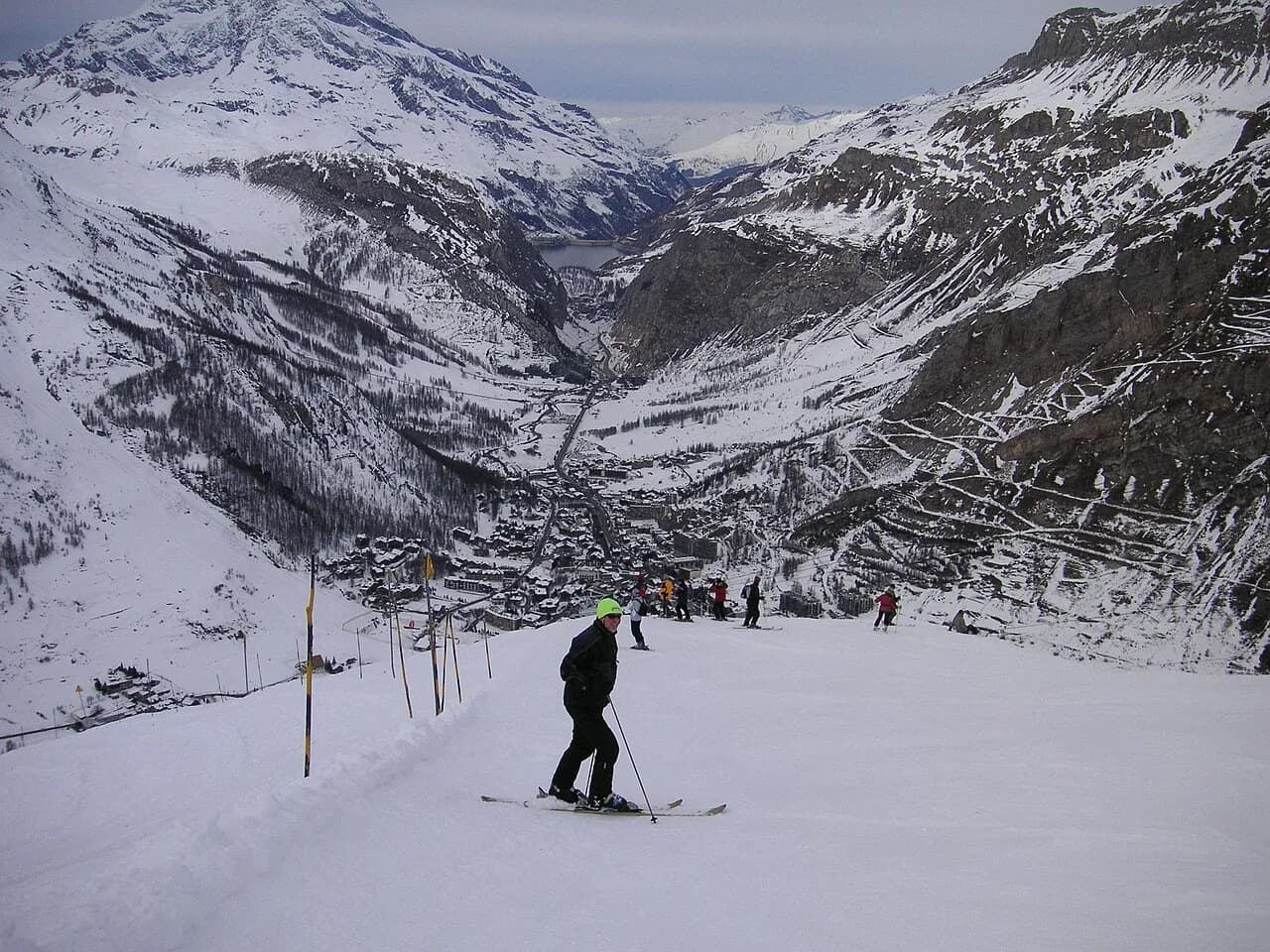
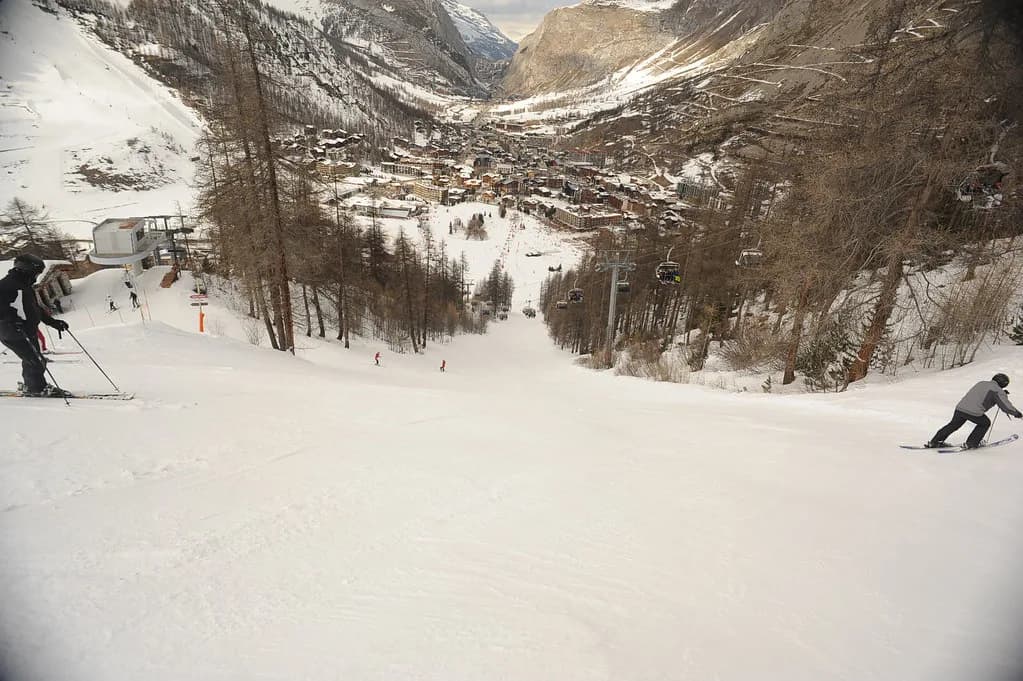
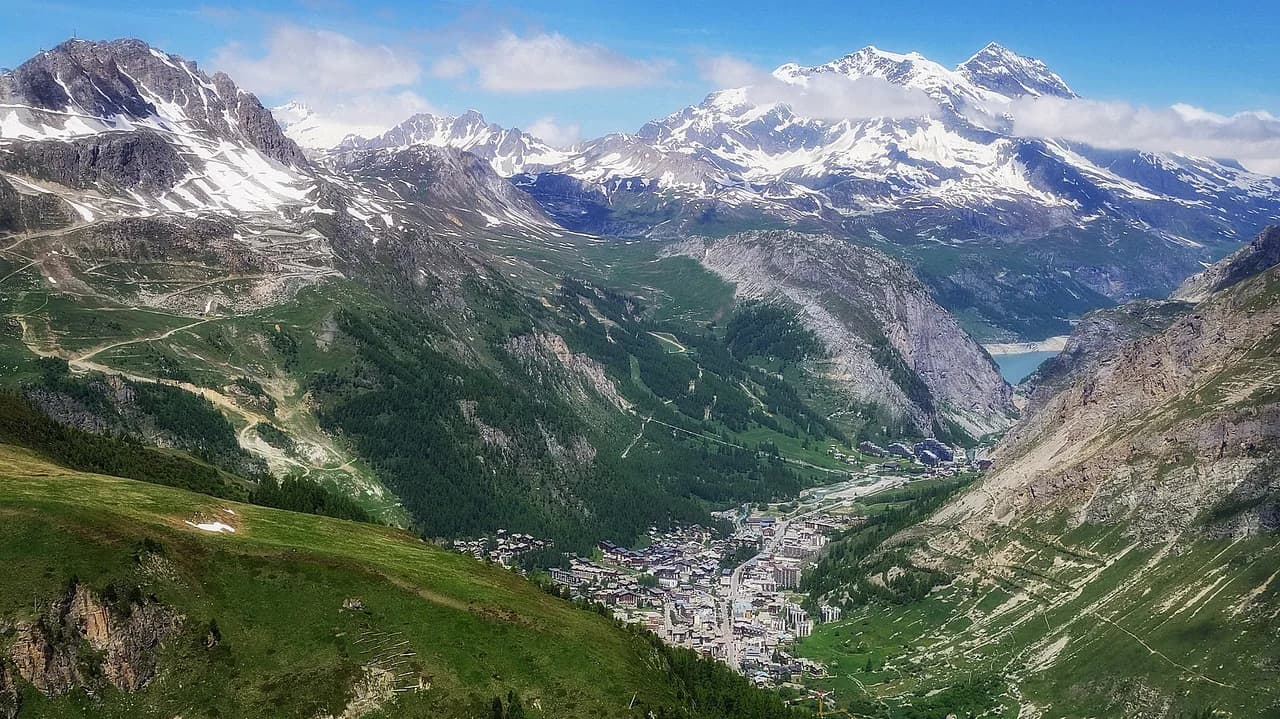
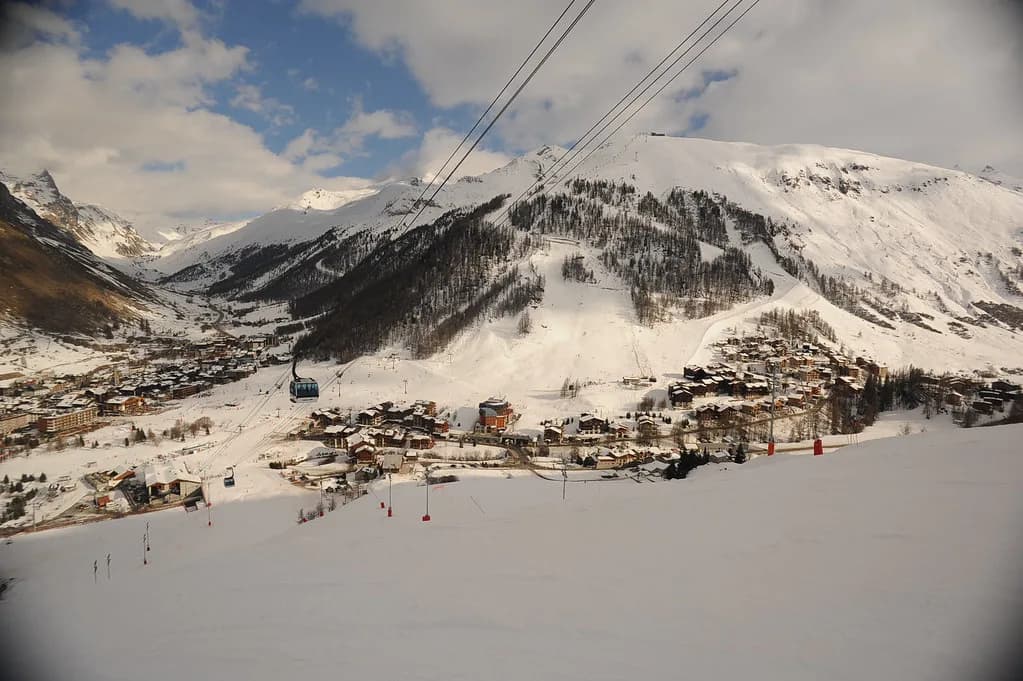
Val d'Isère spreads along the valley with three main access points: the village snow front, La Daille down the road towards Tignes, and Le Fornet further up the valley. Solaise rises directly above the village and is the gentler, more family-oriented side, while Bellevarde is the steeper face that hosts the classic men's racing piste.
Where you sleep changes your morning. Staying in La Daille puts you minutes from the Tignes boundary and the faster route onto the high terrain; staying in the village centre gives you the snow front, the Savonnette learning slope and the widest choice of restaurants on foot.
The whole layout only makes sense with the piste map open, so study it before you commit to accommodation.
Lift-pass choice follows the same geography. A full-area pass unlocks Tignes, the glacier and the link, while a Tignes-only product costs less but cuts you off from Solaise, Bellevarde and Le Fornet. Read the detail in the Tignes–Val d'Isère ski area guide before you decide which one your group actually needs.
Season calendar in bands: late-November opening, pre-Christmas preview pricing, full winter, and the late-April to early-May finale
Tignes publishes its 2026-27 prices in four bands, and they are a good proxy for how demand moves through the winter. The opening period from 21 to 27 November 2026 is sold at a single flat day rate of 50,00€.
The avant-première band runs from 28 November to 11 December 2026 while the Val d'Isère link opens gradually: a full-area adult day pass is 67,00€, a half-day afternoon 54,00€, and a six-day pass sold as seven days 402,00€. Child and senior rates for the same products sit at 54,00€, 44,00€ and 324,00€.
From 12 December 2026 to 23 April 2027 the full winter rates apply: 78,00€ for an adult full-area day, 63,00€ for a half-day, and 468,00€ for the six-day product, with child and senior equivalents at 63,00€, 51,00€ and 378,00€. The closing week from 24 April to 2 May 2027 drops back to the avant-première level of 67,00€ a day and 402,00€ for six days.
These are Tignes' published figures for one winter and can change, so confirm the current list before you budget. The pattern is the useful part: the first two weeks of December and the final week of April are where the savings sit.
Early season: what actually opens first, why the Tignes link matters, and who should book the first weeks
In late November you are skiing the high, north-facing terrain that retains snow best, reached by the lifts that serve the upper bowls rather than the runs down to the village. Expect a partial network and a lot of cruising on a limited number of pistes rather than a full tour of the domain.
The Tignes link is the reason early December is worth considering at all. Until it opens, Val d'Isère is a resort in its own right rather than half of a 300 km area, and the value of a full-area pass is correspondingly lower.
Book the opening weeks if you are an advanced skier chasing quiet slopes and groomed high-altitude pistes, or a family taking advantage of lower prices with modest expectations. Do not book them if a full circuit of the area is the point of the trip.
Christmas and New Year: the busiest window and what to lock in first
The festive fortnight sits inside full winter pricing and is the most heavily booked period of the season. Accommodation and ski school places go first, and group lesson slots for children are typically gone long before the lifts start turning.
Lock in your dates and your lessons before you worry about lift passes, because passes can be bought online right up to arrival and recharged on the spot. Restaurant tables on the mountain and in the village are the other thing worth reserving early if you have a fixed celebration in mind.
Snow at Christmas is usually reliable on the upper mountain but the village snow front can be thin, so choose accommodation with easy lift access rather than relying on skiing to the door.
January to March: the reliable core of the season, half-term timing and snow retention on north-facing slopes
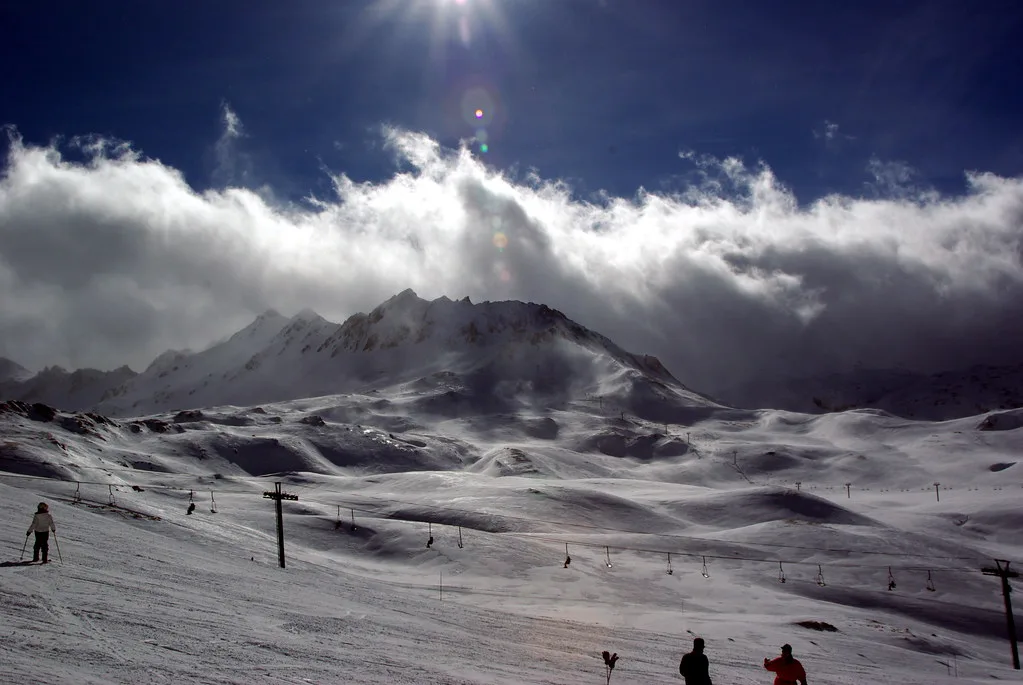
January and the first half of March are the quietest and most consistent weeks, with cold temperatures preserving snow and short lift queues on even the marquee runs. The resort notes that predominantly north-facing slopes hold their cover well, and that cold air lingering at altitude limits melt even as the days lengthen.
Half-term is the exception in February, when the valley fills and the beginner zones and easy blue runs become the busiest parts of the mountain. If you are travelling with novice skiers that week, start early and use the upper sectors once the lower slopes clog up.
Intermediates get the best of this core window: the wide cruising on Solaise and the long descents towards La Daille and Le Fornet are at their most forgiving.
April and early May: spring skiing, altitude advantage and what closes as the season winds down
Spring in Val d'Isère works because the top of the domain stays cold while the valley warms. The resort cites a skiable range of 1,850 m to 3,230 m for its spring product, and the high, north-facing terrain stays firm through the morning before softening after lunch.
The closing week from 24 April to 2 May 2027 is priced at the lower avant-première level, which is why late April appeals to skiers who care more about long sunny lunches than fresh powder. Expect lower runs to thin out and lift hours to stretch later in the day as the season closes.
Snow reliability: altitude, snowmaking coverage, north-facing terrain and the retour d'Est effect
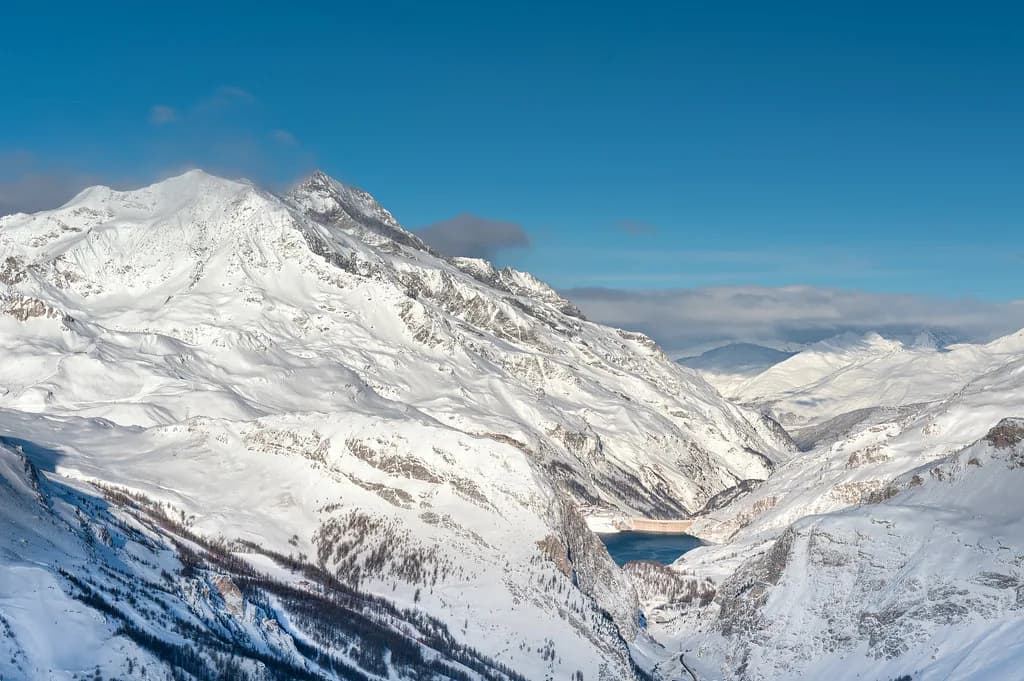
Val d'Isère backs its reputation with more than 65 km of snowmaking, a network that secures the main arteries from early winter rather than guaranteeing every run. Combined with north-facing slopes and cold temperatures at altitude, that gives a base that holds through the season.
The resort also benefits from its position near the Italian border, where the retour d'Est weather pattern delivers intense, localised snowfall. That is a real advantage for snow depth but it also brings storm days when high lifts close, so plan at least one flexible day into a short trip.
Anyone who has skied the Alps knows that a low-altitude resort can lose its valley runs in a poor December while this domain keeps its upper mountain open. That is the trade-off you are paying for.
Beginner and family timing: Famille Plus status, the Savonnette green, free lifts and ValKids areas
Val d'Isère holds Famille Plus certification and lays out its beginner infrastructure deliberately: a Jardin des Neiges on the snow front, the Savonnette green run directly above the village, and ValKids play areas on Solaise. Several free lifts serve the first turns, which keeps the cost of a nervous first day low.
For beginners, the best weeks are January and the first half of March, when the snow front is quiet and instructors have room to work. Christmas and half-term are the worst times to learn, simply because the learning slopes are the most crowded terrain in the resort.
Book lessons before you book anything else, because ski school capacity rather than lift capacity is the real constraint in family weeks.
Lift-pass products and price bands: full area vs Tignes-only, child, senior and free under-8s and over-75s
Tignes publishes two parallel product families: one for the shared Tignes-Val d'Isère area and one for the Tignes sector alone. In full winter the Tignes-only adult day pass is 70,00€ against 78,00€ for the full area, so the saving is modest and only makes sense if you never plan to cross into Val d'Isère's sectors.
Age rules are unusually generous on the shared pass: under-8s ski free, the child rate applies up to and including 18, the senior rate starts at 65, and over-75s ski free. Holders of a disability card and their accompanying person each receive 50 per cent off, provided both passes are bought together at the ticket office for the same duration and area.
A family with teenagers therefore pays child rates for skiers who would be adults almost anywhere else, which can swing the value calculation well away from cheaper-looking resorts. Run your own group through the published bands before comparing headline day prices elsewhere, and see the val d'isère ski pass breakdown for how the products fit together.
Where and when to buy passes, and how to handle ski school and hire bookings
Buy or recharge passes online or through the resort app before you travel, and collect them from the express terminals if you prefer to sort it on arrival. The resort recommends sorting passes in advance precisely so that the first morning is spent skiing rather than queueing.
Ski school bookings are the item to secure earliest, especially for children's group lessons in the festive and half-term weeks. Independent instructors and ski touring guides are an alternative for adults who want to work on technique or head into the marked touring zones.
Hire shops cluster around the village snow front and La Daille, so pick one near your accommodation and collect skis the afternoon before your first day rather than joining the morning rush.
Getting there in winter and getting around once you arrive
Val d'Isère sits at the end of the Tarentaise valley, reached by road from Bourg-Saint-Maurice, which has rail connections and is the nearest practical station. Winter driving means chains or winter tyres on the final climb, and Saturday transfers are the slowest of the week.
Once you are in the resort, free shuttles run across the village from morning to night, so a car is more hindrance than help for the week. Park it and use the buses to reach the snow front, La Daille and Le Fornet.
Travelling midweek rather than on a Saturday smooths the whole journey, from the airport transfer to the lift-pass queue on your first morning.
Hardest and most demanding terrain, and when in the season to attempt it
The Face de Bellevarde is the run that defines the resort's reputation: the 1992 Albertville Olympic men's downhill course, the World Championships piste and the annual Critérium de la Première Neige venue. It is steep, exposed and intended for advanced skiers, and the resort is explicit that beginners should stay off it.
The best window for the Face and the other black terrain is mid-January to March, when the surface is cold and grippy and the bumps have had time to form. Early season it is often closed or dangerously thin, and in late April the softened snow demands a different technique.
Off-piste skiers should go with a guide and check the avalanche bulletin daily; the resort's marked ski touring zones are the sensible entry point for anyone new to the area.
Who the Val d'Isère season suits and who should look elsewhere
The season suits skiers who value a long, reliable window and a big linked domain: intermediates who want to cruise, advanced skiers who want the Face and the off-piste, and families who benefit from the child-rate rules and the beginner infrastructure. The trade-off is cost, because full winter pricing is at the top of the French market.
If your priority is a short, cheap December break with no interest in a large area, the avant-première weeks work well; if you want guaranteed village-level snow in early season, a higher base such as Alpe d'Huez is worth comparing.
Plan Your Visit
Treat the published calendar as your planning frame and the snow report as your daily truth. Book early December or late April for value, January and early March for quiet pistes, and the festive weeks only if you have secured lessons and accommodation well in advance.
Check current prices and dates on the resort's own pages before you commit, since the figures here describe one winter and are subject to change. Start with the val d isere skiing overview and build the rest of the trip around the weeks that fit your group.
Frequently Asked Questions
When does the Val d'Isère ski season start and finish?
The resort plans its winter from 28 November 2026 to 2 May 2027, with the full linked Tignes-Val d'Isère area priced as a complete domain from 12 December 2026 to 23 April 2027. Tignes opens its own sector from 21 November 2026. These are published plans, and daily lift and piste opening still depends on snow, wind and weather.
Is Val d'Isère snow-sure in December?
The upper mountain is generally reliable in December because it sits above 2,500 m with north-facing slopes and extensive snowmaking, but the village snow front can be thin in a poor early season. The Tignes link is scheduled from 28 November, and the full-area pass only becomes worthwhile once it opens. Check the snow report before booking a December trip based on village-level skiing.
What is the best month to ski Val d'Isère?
January and the first half of March give the best combination of cold snow, quiet pistes and full-area access. Christmas and half-term are the busiest weeks, while late April offers softer snow, long sunny days and lower prices but with lower runs thinning out. Advanced skiers chasing the Face de Bellevarde should aim for mid-January to March.
How much is a Val d'Isère lift pass for a week?
Tignes publishes a six-day product sold as seven days: in full winter 2026-27 it is priced per adult for the shared area, with a lower rate for children and seniors and cheaper bands in early December and late April. Under-8s and over-75s ski free, and the child rate runs to 18. Confirm the current list before you budget.
Is Val d'Isère good for beginners?
Yes. The resort holds Famille Plus certification and provides a Jardin des Neiges on the snow front, the Savonnette green run above the village, free lifts for first turns and ValKids play areas on Solaise. Beginners do best in January and early March, when the learning slopes are quiet. Christmas and half-term are the most crowded times to learn.
What is the hardest run in Val d'Isère?
The Face de Bellevarde is the signature steep run, used for the 1992 Olympic men's downhill, a World Championships piste and the annual Critérium de la Première Neige. It is intended for advanced skiers, and the resort advises beginners to stay off it. Mid-January to March gives the best surface conditions.
Can you ski Val d'Isère in April?
Yes. The season runs into early May, and the final fortnight from 24 April to 2 May 2027 is priced at the lower early-season level. Spring skiing concentrates on the high, north-facing terrain, with lower runs thinning as the valley warms. Expect firm mornings and softer snow after lunch.
Is Val d'Isère more expensive than other French resorts?
Full winter pricing sits at the top of the French market, but the age rules soften the blow: under-8s and over-75s ski free, child rates run to 18 and senior rates start at 65 on the shared pass. Booking the early December preview or the final April week brings costs down substantially. Compare those bands rather than the headline day rate.
Sources
Useful notes for your next ski trip
Optional updates to our Alpine resort guides.
You might also like
Continue reading
More guides you'll find useful