Sölden Skiing Guide: Three Sectors, Big 3 Peaks and Pass Choices
Plan a Sölden ski trip with a clear look at the Giggijoch, Gaislachkogl and glacier sectors, the Big 3 layout, terrain by ability and pass boundaries.
On this page
Sölden rewards a specific kind of ski trip: one where you want altitude, a long operational window and enough terrain to keep a mixed group busy for a week. It is not a compact village hill where everything funnels back to one base, and it is not a quiet glacier-only area with a handful of lifts. The layout asks you to think in sectors and to accept that moving between them costs time.
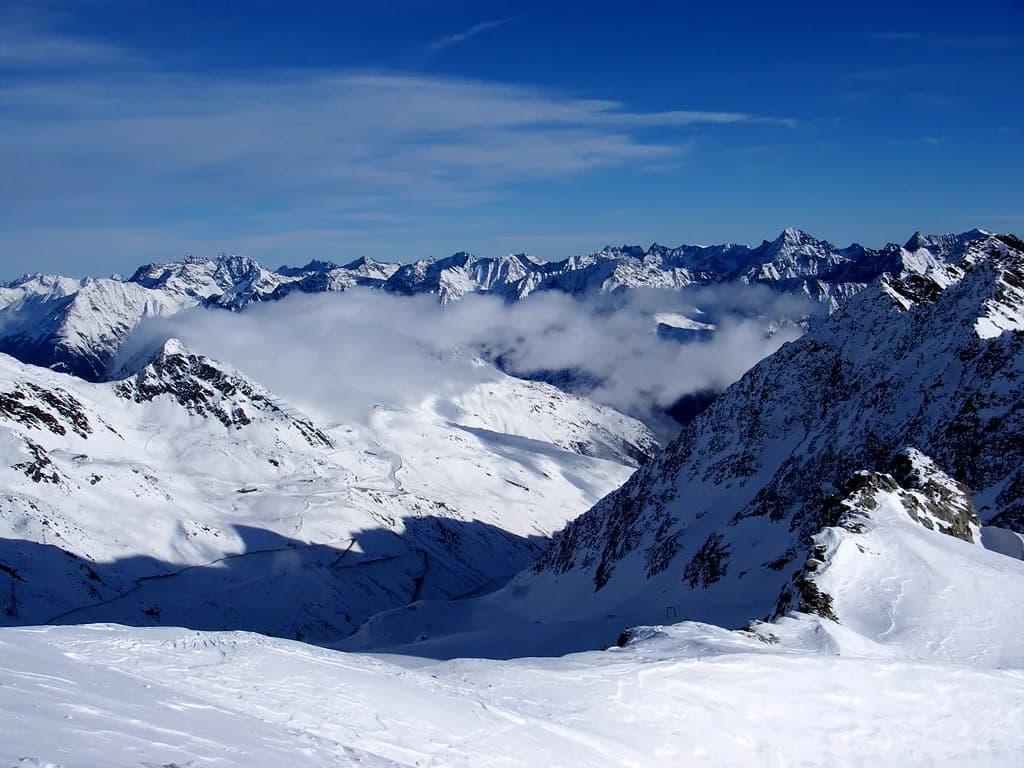
The resort sits in the Ötztal in Tyrol, Austria, with the village at 1,377 m and the ski area reaching 3,340 m. Three sectors — Giggijoch, Gaislachkogl and the Rettenbach and Tiefenbach glacier area — are threaded together by a lift network that includes gondolas, chairlifts, T-bars and conveyor belts. A reported season span from September to May is a scheduled window, not a promise that every lift, link or piste will operate on any given date.
Use this guide as a decision framework: choose your sector priorities, understand the published terrain split, and settle pass and lesson questions before you commit money. Detailed operational detail sits in the linked spoke guides.
Where Sölden sits and what kind of resort it is
Sölden is a village and ski area in the Ötztal valley in Tyrol, Austria, and the resort identity matters for planning because the ski area is large, high and spread across three separate mountain sectors. Bergbahnen Sölden runs the lifts, and the village sits at the valley floor rather than mid-mountain, so most days start with a gondola ride. If you are comparing Austrian destinations, this is an altitude-and-scale choice rather than a quaint-village choice.
The resort is known for a wide piste network and a glacier ski area that reaches 3,340 m, with the season starting in September and ending in May according to the tourism board. The area also has the only ski terrain in Austria with access to three mountains above 3,000 m, which is the basis of the Big 3 concept. Treat those dates as the documented operational window rather than a condition guarantee.
That combination — valley base, high top station, multiple sectors — drives everything else in this guide. It affects how you buy a pass, where beginners spend their time, and how much of the area a short break can realistically cover.
The three sectors at a glance
Sölden's ski terrain is divided into three main sectors: Giggijoch, Gaislachkogl, and the glacier area. The three are linked by a system of gondolas and chairlifts, and each sector has a distinct character and a different job in a ski week. Understanding which sector does what is the single most useful planning step.
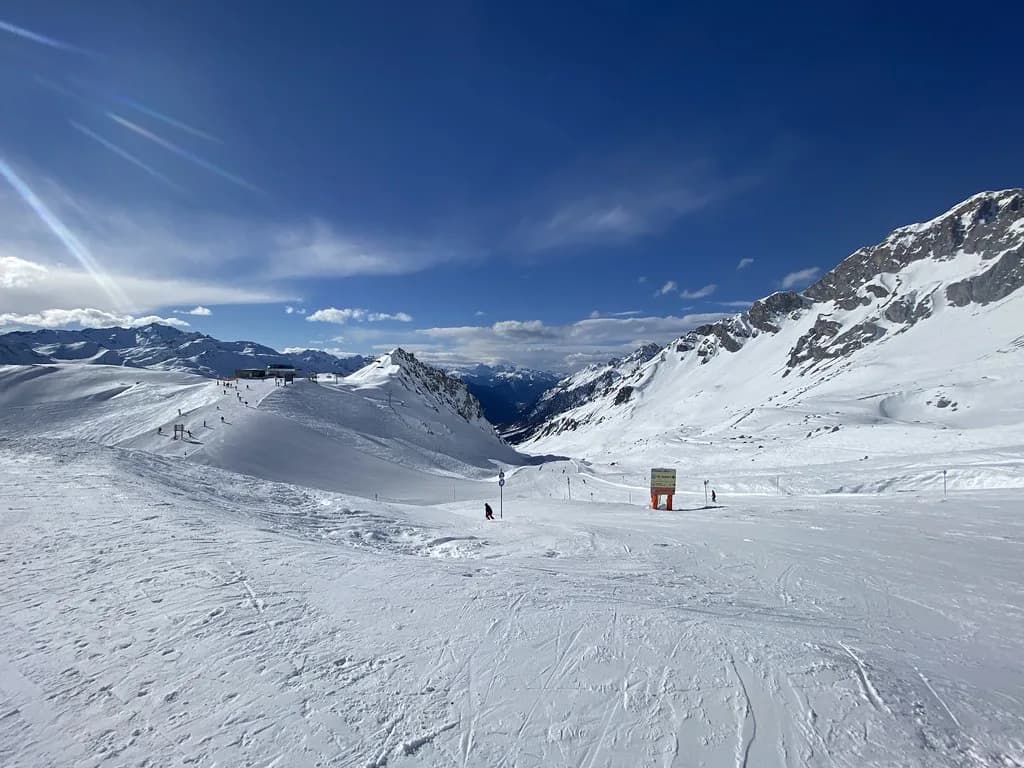
Giggijoch is the most central of the three and is often the first sector reached from the village, with a mix of blue and red runs and a freestyle park zone. Gaislachkogl rises to 3,058 m and carries long descents as well as a summit role in the Big 3 circuit. The glacier area, reached via the Rettenbach and Tiefenbach glaciers, includes the Schwarze Schneide high point at 3,340 m and is the part that extends the season.
The practical consequence is that a day spent crossing all three sectors is a long day with significant lift time. A trip that treats them as separate days — one for the glacier, one for Gaislachkogl, one for Giggijoch — usually gets more skiing and less queueing.
Giggijoch: the central, mixed-ability sector
Giggijoch functions as the central hub of the ski area, with a variety of blue and red runs that make it a sensible starting point for intermediates. It is also where the area's snowpark sits, which makes it the natural sector for freestyle riders and for anyone in a group who wants laps rather than a summit expedition. Its position in the lift network means it is often the sector you pass through rather than the one you commit a whole day to.
For mixed groups, Giggijoch is the sector that most easily serves different ability levels at the same time, because the terrain around it includes both gentle and more demanding runs. That makes it a good default meeting point if your group splits during the day. It also means the sector can feel busier than the glacier or Gaislachkogl on peak days.
The snowpark on Giggijoch is a documented feature of the area and is one reason snowboarders often gravitate here. If your group includes a freestyle rider, plan at least part of a day in this sector rather than treating the park as an afterthought.
Gaislachkogl: long descents and a Big 3 summit
Gaislachkogl is the 3,058 m peak sector that combines long descents with a summit viewpoint role. It is one of the three Big 3 mountains — the others being Tiefenbachkogl and Schwarze Schneide — and each has a viewing platform at the top. The sector rewards skiers who are comfortable on red and black terrain and who are willing to commit to longer runs.
The mountain also hosts the 007 ELEMENTS attraction at the original filming location, which makes it the sector with the strongest non-skiing draw. If you want to combine a summit visit with a long descent, Gaislachkogl is the sector to schedule deliberately rather than stumble into. The mid-station Gaislachkogl Gondola is also the start point for a 7 km toboggan run to the valley floor.
One documented route from the top of Schwarze Schneide descends 15 km into the valley, which is a useful benchmark for how much vertical the area can deliver in a single run. The practical cost is leg fatigue and lift time, so plan a long run as the centrepiece of a day rather than as an add-on to a sector-hopping itinerary.
The glacier area: Rettenbach, Tiefenbach and Schwarze Schneide
The glacier sector includes the Rettenbach and Tiefenbach glaciers and the Schwarze Schneide high point at 3,340 m. It is the part of the area that extends the season well beyond the conventional alpine winter, with the tourism board documenting a September-to-May window. Glacier access is the single strongest reason to choose Sölden for an early- or late-season trip.
Terrain character differs between the two glaciers: the steeper descents sit on the Rettenbach side, while the Tiefenbach side is described as gentler and wider, which is more suited to less experienced skiers. That distinction is worth knowing before you commit a novice to a glacier day. It also means the glacier sector is not a single uniform experience — the two halves serve different groups.
Because the glacier sits at the top of the lift network, reaching it takes time from the village. A glacier day is usually a full day, not a half-day excursion, and it is best scheduled early in a trip so that you can return if weather or operations interrupt the first attempt.
The Big 3 circuit and what it asks of a skier
The Big 3 is a circuit across the three peaks above 3,000 m — Gaislachkogl, Tiefenbachkogl and Schwarze Schneide — each with a viewing platform at the summit. Sölden markets it as a rally-style challenge that skiers can complete across the ski area. The published material confirms the three peaks and their platforms; it does not confirm a distance for the full circuit.
One third-party guide describes the Big 3 Rally as a 50 km route, but that figure is not corroborated by Bergbahnen Sölden or Ötztal Tourismus. Treat the distance as unconfirmed and plan the circuit by time and leg feel rather than by a quoted kilometre count. If you want a precise distance, ask at the Bergbahnen Sölden information point or read the current on-mountain signage.
The practical cost of the circuit is not the skiing difficulty alone; it is the lift transfers between three separate peaks, the altitude, and the fact that a full crossing leaves little room for repeated laps. A sensible approach is to ride the circuit once as an orientation day, then return to whichever sector suited you best for the rest of the trip.
Terrain distribution by ability: reading the published split
Published difficulty splits for Sölden do not agree. Ötztal Tourismus lists 49 percent easy, 32 percent medium and 19 percent difficult, plus ski routes, across 142 km of pistes. A third-party guide lists 28 percent blue, 48 percent red and 24 percent black across 144 km. These figures cannot both be correct, and the tourism board's numbers are the safer basis for planning.
The two sources agree that the area is genuinely mixed rather than dominated by one tier. What that means in practice is that a group with a range of abilities can find suitable terrain without splitting up permanently, but the share of difficult terrain is large enough that confident intermediates will not run out of challenge. The discrepancy is a reason to check the current piste map rather than rely on a single percentage.
If terrain difficulty is central to your decision, the honest position is that published splits differ and that the piste map is the authoritative tool. Use the percentages as a rough orientation, not as a precise contract.
Beginner provision: Innerwald and the wide blues around Hochsölden
Novice terrain is concentrated rather than spread across the whole area. The Innerwald area at the bottom of the resort is described as suitable for beginners, with gentle slopes and dedicated learning zones, and the wider blue runs around Hochsölden — such as runs 36 and 37 — give progressing beginners room to build confidence. That pairing matters: one zone for first turns, another for the step up.
The area's beginner provision is real but not the resort's headline strength, and a complete novice week will mostly be spent in a small number of zones rather than touring the whole mountain. Groups with a true first-timer alongside strong skiers should expect to make a clear daily plan about who is where. The high proportion of easy piste kilometres in the official Ötztal Tourismus figures is encouraging, but it does not mean every beginner run is conveniently placed.
A practical approach is to treat the first two days as learning-zone days and only then attempt the step up to the wider blues. That sequencing also gives you time to confirm which uplift is actually running on your dates.
Lessons and hire: what to settle before you commit
Lessons and equipment hire are bookable on-resort services, and the resort is listed as having both a ski school and ski rental presence. What that does not tell you is the specifics: group sizes, languages, meeting points, instructor qualifications, rental fleet and whether kit can be reserved in advance. Those details come from the individual school and shop, not from the resort's existence as a service centre.
The sensible pre-trip questions are narrow. Ask each school directly about lesson format, meeting location, cancellation terms and whether lift passes are included or extra. For equipment, ask about reservation, fitting time, and what happens if your plans change. Do not assume that a well-known brand or a convenient location implies a particular standard of service.
For equipment, the same discipline applies. booking your solden ski hire before arrival is often easier than queuing in the village on a peak morning, but confirm the shop's policy on changes and returns before you pay.
Pass boundaries and why inclusions must be verified
Sölden operates as a single Sölden ski area for the core lift network, and the tourism board lists the Snow Card Tirol and Tirol Regio Card among the valid passes alongside the local option. That means the pass decision is not just about Sölden itself; it is about whether you want a wider Tyrol product or a resort-only product. The two serve different trip shapes.
Bergbahnen Sölden has not published, on the pages covering the ski area and valid passes, a breakdown of which lifts, sectors or glacier access each pass includes, and no current price list appears there either. Pass inclusions differ by product and season, so confirm the covered lifts for the product you are considering with the lift company or the pass issuer before purchase. Do not assume that a regional pass automatically covers every part of the Sölden area, or that a local pass covers everything a regional one does.
The practical decision is to choose between a resort-focused pass and a broader Tyrol product based on how many days you will ski in Sölden and whether you plan to ski elsewhere. Once you have that answer, confirm the inclusions and current terms directly. Our solden ski pass guide breaks down the questions to ask.
If you are comparing Sölden with another Austrian destination, the pass structure is a legitimate differentiator. Ischgl skiing and Alpbach skiing sit in different lift-pass systems, and comparing boundaries is more useful than comparing marketing claims. The same is true of the Kaprun Ski guide, which sets out how Kitzsteinhorn, Maiskogel and local passes fit together.
Altitude and season shape: scheduled versus open
Sölden spans 1,377 m at the village to 3,340 m at the Schwarze Schneide, and the glacier sector is the reason the documented season stretches from September to May. That altitude range is the resort's core structural advantage for early- and late-season trips. It is also the reason to distinguish a scheduled season from actual operations.
A scheduled window means Bergbahnen Sölden plans to run at those times; it does not mean every lift, link or piste will be open on your dates. Glacier access, connecting lifts and lower runs can all be affected by conditions and maintenance. Historic season patterns are not forecasts for a future trip, so check the live lift and piste status close to departure rather than relying on last year's experience.
For a trip that depends on the glacier being open, build in flexibility. An early-season or late-season booking carries more operational uncertainty than a mid-winter one, and a refundable or movable booking policy is worth more than a small saving. If your dates are fixed and glacier access is essential, say so when you book.
Planning sequence: matching sectors, ability mix and pass choice
Start with your group's ability mix rather than with the resort's headline statistics. A group of confident intermediates will get the most from Gaislachkogl and the glacier, while a group with beginners should plan around Innerwald and the wider blues and treat the glacier as an optional day. The sector layout is what makes this decision concrete.
Next, decide how many days you will ski and whether you want a Sölden-only pass or a wider Tyrol product. That choice changes both cost and flexibility, and it should be made before you book accommodation or lessons. Verify current inclusions and terms with the operator rather than relying on a general description.
Then sequence the week: one orientation day across sectors, a glacier day, a Gaislachkogl day and a Giggijoch day is a reasonable default for a mixed group. Book lessons and hire early, especially in peak weeks, and confirm meeting points and equipment collection in advance. Finally, plan for at least one flexible day in case the glacier or a connecting link is not running on your chosen date.
Plan Your Sölden Trip
Sölden suits skiers who want altitude, a long operational window and a genuinely large three-sector area, and it suits them best when the trip is planned around sectors rather than around a single resort centre. The glacier sector is the structural reason to choose it for early- or late-season dates, while Giggijoch and Gaislachkogl carry the bulk of a normal week.
The decisions that matter most are pass boundaries, sector sequencing and the ability mix of your group. Settle those before you book lessons or hire, check current inclusions and operating status with Bergbahnen Sölden, and treat the documented September-to-May window as a plan rather than a promise.
Explore more Solden guides
Frequently Asked Questions
Where is the Sölden ski area?
Sölden is in the Ötztal valley in Tyrol, Austria. The village sits at 1,377 m and the ski area reaches 3,340 m at the Schwarze Schneide, with three main sectors — Giggijoch, Gaislachkogl and the glacier area — connected by a lift network.
How do the three Sölden ski sectors connect?
Giggijoch, Gaislachkogl and the glacier area are linked by a system of gondolas and chairlifts. Crossing all three in one day involves significant lift time, so many skiers treat each sector as a separate day rather than trying to cover everything at once.
What is the Sölden skiing difficulty split?
Published figures conflict. The tourism board lists 49 percent easy, 32 percent medium and 19 percent difficult across 142 km of pistes, while a third-party guide lists 28 percent blue, 48 percent red and 24 percent black across 144 km. The piste map is the authoritative tool for planning.
Is Sölden good for beginners?
Yes, with caveats. The Innerwald area at the bottom of the resort has gentle slopes and dedicated learning zones, and the wider blue runs around Hochsölden such as runs 36 and 37 give progressing beginners room. A complete novice week will be spent in a small number of zones rather than touring the whole mountain.
How long is the Sölden ski season?
The tourism board documents a season from September to May, thanks to the glacier sector. That is a scheduled window, not a guarantee that every lift, link or piste will be open on any given date, so check live operating status close to your trip.
What passes are valid in Sölden?
The tourism board lists the Snow Card Tirol and Tirol Regio Card among valid passes alongside the local Sölden option. Bergbahnen Sölden does not publish a per-product breakdown of covered lifts on its ski-area pages, so confirm inclusions and current terms with the lift company or the pass issuer before you buy.
Which ski pass covers the Sölden glacier area?
Sölden operates as a single ski area, with the Snow Card Tirol and Tirol Regio Card listed as valid passes. The sources do not specify which lifts or sectors each pass includes, so it is unclear whether glacier access is covered by the product you are considering.
What is the Big 3 in Sölden?
The Big 3 refers to three peaks above 3,000 m — Gaislachkogl, Tiefenbachkogl and Schwarze Schneide — each with a viewing platform at the summit. They form a circuit across the ski area. A widely quoted 50 km distance for the full rally is not confirmed by an official source.
Sources
Useful notes for your next ski trip
Optional updates to our Alpine resort guides.
You might also like
Continue reading
More guides you'll find useful